
The Evolution of Punjabi Cinema’s Leading Men
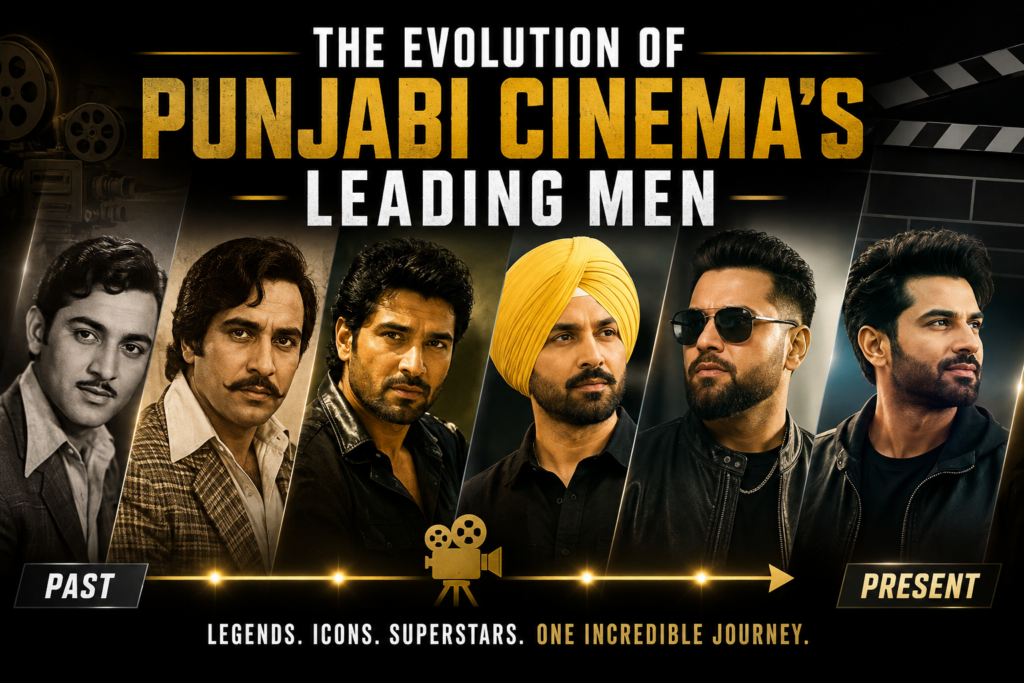
The changing era of leading men in Punjabi cinema
Punjabi cinema has undergone a major transformation over the past two decades, and one of the clearest signs of that change is the evolution of its leading men.
The Punjabi hero is no longer defined by a single image. Earlier, the industry’s leading actors were often associated with comedy, romance, music and family entertainment. Today, Punjabi cinema’s male stars are increasingly moving between comedy, action, drama, social subjects, serious characters and commercially ambitious projects.
This evolution reflects a wider change in the Punjabi audience. Viewers have become more exposed to Indian and international cinema, while the global Punjabi diaspora has created a much larger market for Punjabi films.
From established stars to younger actors, the definition of a Punjabi film hero is changing.
From Singer-Actors to Full-Fledged Film Stars
Music has always been closely connected with Punjabi cinema.
Many successful Punjabi actors have also been singers, which gave them an existing fan base before they entered films. This created an unusual advantage for the industry: a performer could bring an audience from music into cinema.
However, over time, the expectations from a leading actor increased.
A successful Punjabi film star today needs more than a popular song or strong screen presence. Audiences increasingly expect acting ability, character variety, strong scripts and the ability to carry different genres.
This has gradually moved Punjabi cinema from a predominantly personality-driven model towards a more diversified star system.
Gippy Grewal and the Rise of the Modern Commercial Hero
Gippy Grewal represents one of the most important transitions in modern Punjabi cinema.
Having already established himself as a major Punjabi singer, Grewal successfully expanded into acting and eventually became involved in film production as well.
His filmography has covered comedy, romance, action and family entertainment.
The Carry On Jatta franchise is particularly significant because it demonstrated the commercial potential of Punjabi comedy on a large scale. At the same time, projects such as Manje Bistre, Ardaas and action-oriented films showed that his screen identity could extend beyond one genre.
His journey also reflects another important development: the modern Punjabi star can increasingly become an actor, singer and producer at the same time.
That combination gives leading performers greater control over their careers and allows them to participate in the business side of filmmaking.
Diljit Dosanjh and the Expansion of the Punjabi Star
Diljit Dosanjh represents another major stage in the evolution of Punjabi cinema.
Like several Punjabi stars, he entered films with an established music career. But his popularity eventually expanded far beyond the traditional Punjabi entertainment market.
Films such as Jatt & Juliet, Punjab 1984, Udta Punjab, Good Newwz and Jogi demonstrated different sides of his acting career.
His success is important not only because of individual films but because it illustrates how a Punjabi performer can build recognition across languages and industries.
His international music career has also strengthened his visibility among the global Punjabi audience.
For Punjabi cinema, this creates an important model:
A star’s film audience can now be supported by music, social media, live performances and cross-industry appearances.
The result is a much broader definition of star power.
Ammy Virk and the New Generation of Leading Men
Ammy Virk represents a younger generation of Punjabi stars who grew up in an entertainment environment where music, digital platforms and cinema are closely connected.
He established himself through music before becoming a recognised film actor and has worked across comedy, romance, drama and mainstream commercial cinema.
Films such as Bambukat, Qismat, Qismat 2, Sufna and Honsla Rakh helped establish his position as one of Punjabi cinema’s prominent contemporary actors.
His career also demonstrates how the Punjabi audience can support actors who combine emotional storytelling with mainstream entertainment.
The growth of actors such as Ammy Virk suggests that the industry is gradually moving towards a wider pool of leading men rather than depending on only one or two major stars.
Binnu Dhillon and the Power of the Supporting Lead
The evolution of Punjabi cinema is not only about traditional heroes.
Binnu Dhillon is a strong example of how a performer can build enormous commercial recognition without always occupying the conventional romantic-hero role.
His strength in comedy and supporting characters has made him an important part of Punjabi commercial cinema.
This is significant because Punjabi films often depend on ensemble comedy and character-driven entertainment.
Instead of a film being built entirely around one hero, several performers can contribute to its box-office appeal.
That model has helped create a distinctive Punjabi comedy ecosystem.
Dev Kharoud and the Rise of the Action Hero
Another important change has been the growth of action-oriented Punjabi cinema.
Dev Kharoud has become strongly associated with action and serious roles, providing an alternative to the traditional comedy-romance image of the Punjabi hero.
Films such as Rupinder Gandhi 2, Dakuan Da Munda, Blackia and other action-driven projects have helped demonstrate that Punjabi audiences can support films built around crime, revenge, struggle and intense characters.
This has expanded the industry’s genre possibilities.
The commercial performance of action films can also help production houses diversify their portfolios instead of relying almost entirely on comedy.
The Rise of Genre Diversity
The modern Punjabi leading man is increasingly expected to move between genres.
Comedy remains a major part of the market, but Punjabi actors are now appearing in:
- Romantic dramas
- Family entertainers
- Action films
- Social dramas
- Biographical stories
- Historical subjects
- Crime stories
- Cross-industry films
- Experimental projects
This diversification is important for the long-term health of Punjabi cinema.
If every leading actor is associated with the same type of film, the market can become repetitive. Different genres allow production houses to target different sections of the audience.
Star Power Is Changing
Earlier, star power could often be measured through a relatively simple question:
Can the actor bring people to theatres?
Today, the equation is more complicated.
A modern Punjabi star’s value can come from several sources:
Music audience + Social media following + Film audience + Overseas popularity + Brand value + Digital reach
This creates a much larger ecosystem around a performer.
An actor with a strong music following can generate attention for a film’s songs. A large social-media audience can amplify trailers and promotional campaigns. Overseas popularity can help a film secure stronger international distribution.
Therefore, modern star power is increasingly about audience ownership across platforms.
Overseas Audiences Have Changed the Punjabi Hero
The global Punjabi audience has played an important role in shaping the industry’s leading men.
Punjabi films are watched by audiences in Canada, the UK, Australia, the United States and other international markets.
This means a leading actor can build a career around audiences living thousands of kilometres away from Punjab.
For some films, overseas performance can make a significant difference to the overall economics of a project.
As a result, production houses increasingly consider international appeal when selecting stories, actors and release strategies.
The Actor-Producer Model
One of the biggest developments in Punjabi cinema has been the rise of actors who also participate in production.
This model gives stars a greater role in deciding:
- Which stories are made
- How films are marketed
- Which actors are cast
- How releases are positioned
- How franchises are developed
- Which markets are targeted
Gippy Grewal is an important example of this model.
The actor-producer structure can create opportunities for performers to develop long-term intellectual properties rather than depending entirely on outside producers.
However, it also increases financial responsibility. A star attached to production has greater control but also greater exposure to the commercial risks of filmmaking.
Social Media Has Created a New Route to Stardom
The rise of Instagram, YouTube and short-form video has changed how Punjabi actors build audiences.
Earlier, an actor’s visibility depended heavily on films, television appearances, music channels and traditional media.
Today, audiences can follow an actor every day.
Behind-the-scenes videos, interviews, song promotions, promotional reels and fan interactions can keep an actor visible between film releases.
This has reduced the gap between film campaigns and everyday audience engagement.
For younger actors, social media can also provide an opportunity to build recognition before receiving a major theatrical role.
What Makes the Next Punjabi Star?
The next generation of Punjabi leading men may not follow the traditional path.
An emerging actor could potentially build an audience through:
YouTube → Music → Instagram → Short-form content → OTT → Punjabi cinema → Pan-India projects
This means future stars may enter cinema with a completely different type of audience base.
The challenge for them will be converting digital popularity into theatrical credibility.
A large online following does not automatically guarantee a successful opening at the box office. Ultimately, the audience must have a reason to purchase a cinema ticket.
The Future of Punjabi Cinema’s Leading Men
Punjabi cinema is moving towards a more competitive and diversified star landscape.
Established names continue to have strong recognition, but younger actors are getting opportunities to build their own identities.
The future leading man may be expected to do much more than play the traditional hero.
He may need to understand music, digital promotion, international audiences, production economics and changing audience behaviour.
At the same time, Punjabi cinema’s strongest advantage remains its connection with its audience.
The industry’s leading men have evolved because the audience has evolved.
From singer-actors and comedy stars to action performers, dramatic actors, crossover artists and actor-producers, the Punjabi hero has become a much broader category.
The Bigger Industry Picture
The evolution of Punjabi cinema’s leading men is ultimately a story about the evolution of the industry itself.
Gippy Grewal helped strengthen the modern commercial star-and-producer model. Diljit Dosanjh demonstrated how Punjabi entertainment can reach audiences across India and the world. Ammy Virk represents a newer generation that successfully combines music and cinema, while performers such as Binnu Dhillon and Dev Kharoud have shown the commercial potential of specialised screen identities.
The next phase will likely be less about finding one biggest Punjabi star and more about building a deeper ecosystem of actors who can succeed in different genres and markets.
For Punjabi cinema, that could be an important advantage.
A wider pool of commercially viable leading men means more stories can be produced, more genres can be explored and more audiences can be targeted.
And ultimately, the strongest stars will not simply be those with the biggest fan following.
They will be the performers who can consistently turn audience attention into theatrical value.
Buy Branded Buy Neonwale NEON LIGHTS
Pollywood Box Office News Network