
Audience Response vs Box Office: Are They Matching?
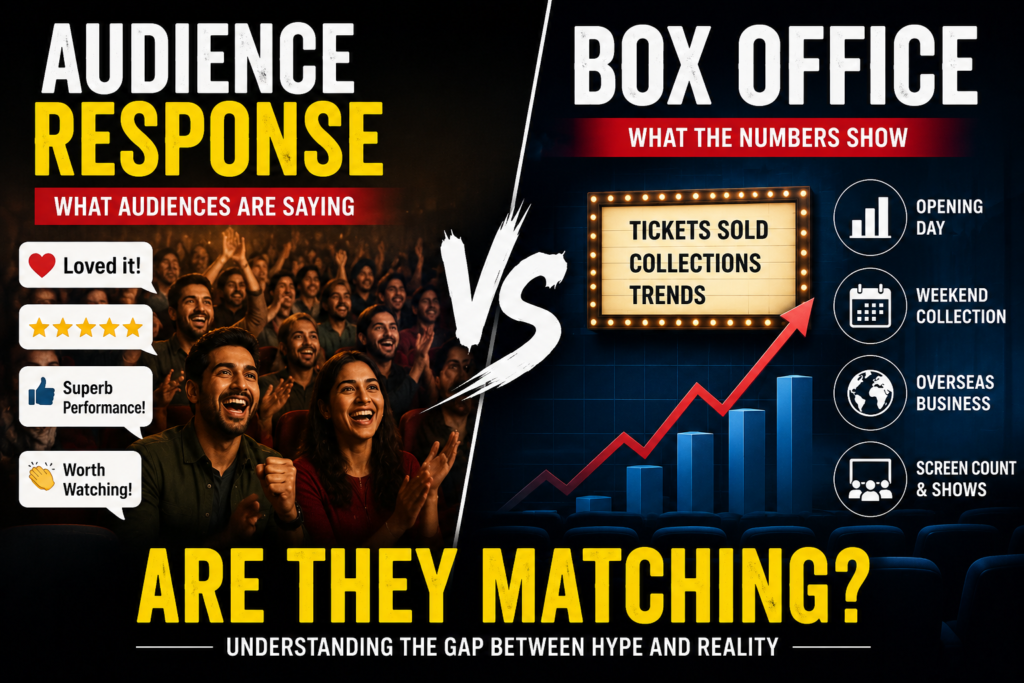
Audience response and box office performance can sometimes tell different stories about a Punjabi movie.
A film can receive positive reactions from audiences and still struggle at the box office. On the other hand, a movie may face mixed reviews online but continue to attract strong theatrical business.
This difference is particularly important when analysing Punjabi cinema. Audience response and box-office collections are connected, but they are not the same thing.
A viewer’s opinion tells us how people feel about a film. Box-office performance tells us how many people actually paid to watch it in theatres.
Understanding the gap between these two signals can provide a much clearer picture of a movie’s theatrical journey.
Audience Response and Box Office Measure Different Things
The simplest distinction is this:
Audience response measures sentiment. Box office measures purchasing behaviour.
Someone can enjoy a movie but watch it only once.
Another person may have mixed feelings but still watch it because of curiosity, friends, a popular actor or a successful song.
Similarly, people who strongly dislike a film may be very active on social media, but their online reactions do not necessarily represent the entire paying audience.
Therefore, online sentiment should not automatically be treated as a box-office forecast.
Why a Well-Received Film Can Have a Weak Box Office
Positive audience feedback is helpful, but it cannot overcome every market limitation.
A film may receive favourable reactions but still face:
- Limited screen availability
- Weak show timings
- Strong competition
- Low pre-release awareness
- A relatively small target audience
- Poor distribution in certain markets
- Unfavourable release timing
For example, a film could have a satisfied audience in the cities where it is playing but still generate modest overall collections because it has fewer shows.
This is why the theatrical performance of a movie should be analysed alongside its distribution footprint.
Why a Mixed-Response Film Can Still Open Strongly
The opposite situation is equally interesting.
A movie can record a strong opening even when audience opinions later become mixed.
The opening may be driven by curiosity, star power, franchise value, trailers, songs, promotional activity or advance bookings.
Some viewers may want to see the film immediately before reading reviews or hearing reactions from others.
This creates a situation where the first few days can be strong even if later audience response becomes less favourable.
The key question then becomes whether the film can maintain demand after the initial audience has watched it.
The Opening Day Does Not Tell the Entire Story
Opening-day numbers mainly tell us about initial demand.
They do not necessarily tell us whether the movie will have a long theatrical run.
For a more complete picture, analysts should examine:
Opening Day → First Weekend → Monday → Weekdays → Second Weekend → Later Weeks
This sequence helps reveal whether audience interest is expanding, remaining stable or declining.
A strong opening followed by relatively stable weekdays can suggest stronger audience retention.
A strong opening followed by a sharp fall may indicate that much of the initial demand was concentrated around release day and the first weekend.
Word-of-Mouth Can Change the Box Office
Word-of-mouth is one of the strongest links between audience response and box-office performance.
If early viewers recommend a movie, potential audiences may become more willing to buy tickets.
This can help a film maintain business beyond its initial fan-driven audience.
Negative word-of-mouth can have the opposite effect.
People who were undecided may postpone their cinema visit or choose another movie.
This is one reason the first weekend and the following weekdays can tell different stories.
Social Media Is Not the Entire Audience
Modern films receive huge amounts of discussion on Instagram, YouTube, Facebook, X and other platforms.
But social media audiences are not necessarily identical to the theatrical audience.
A highly active online community may represent only a small segment of total viewers.
There can also be differences between age groups, cities, countries and language preferences.
For Punjabi cinema, this becomes especially relevant because the audience is distributed across Punjab, other Indian cities and overseas markets.
A social media conversation may be strong in one segment while theatrical demand is behaving differently elsewhere.
Reviews and Audience Reactions Are Different Signals
Professional reviews, audience reviews and social media reactions should not be treated as interchangeable.
A critic may evaluate direction, screenplay, acting, cinematography and technical execution.
A regular viewer may care more about entertainment value, humour, music, emotional connection or whether the film is enjoyable with family and friends.
A film can therefore receive a mixed critical response while generating strong audience demand.
The reverse can also happen.
A technically well-made film may receive praise but struggle to attract enough people to theatres.
Star Power Can Create a Gap
Popular actors and singers can significantly influence opening-day demand.
A loyal fan base may turn up because of the personality associated with the film rather than the movie itself.
This can create an initial box-office boost.
But star power has limits.
If the movie does not connect with a wider audience, the initial advantage may fade after the first few days.
This is why the performance of a star-driven film should be examined across the entire theatrical run rather than judged only by its opening.
Music Can Influence Audience Expectations
Music is particularly important in Punjabi entertainment.
A successful song can create awareness months before a movie’s theatrical release.
Audiences may already know the soundtrack, performers and basic concept before buying a ticket.
This can increase curiosity and contribute to opening-weekend demand.
However, strong music does not automatically guarantee strong movie collections.
If the film itself fails to meet audience expectations, the initial interest generated by its music may not translate into sustained theatrical business.
Genre Also Influences the Relationship
Different genres have different audience behaviours.
Comedy films may depend heavily on group and family audiences.
Romantic films can attract younger viewers and couples.
Action films may benefit from fan-driven opening demand.
Family dramas may depend more heavily on positive word-of-mouth.
This means the same opening-to-weekday pattern should not be applied blindly to every Punjabi release.
A movie needs to be evaluated within the context of its genre, target audience and release environment.
Release Timing Can Distort the Picture
A film released during a holiday period may have access to a larger audience than the same film released during a normal working week.
Festivals, public holidays, school vacations and long weekends can influence theatrical attendance.
This means a strong collection during a holiday cannot automatically be compared with a normal weekday without considering the circumstances.
Similarly, bad weather, examinations, major sporting events or competing releases can affect audience behaviour.
Competition Can Separate Sentiment From Collections
Imagine that audiences generally like a Punjabi film, but a major Bollywood or South Indian release arrives the following week.
The Punjabi film may lose screens or show timings even though the existing audience response remains positive.
In such a case, lower collections do not necessarily mean that the audience suddenly disliked the movie.
The available theatrical space has changed.
This is why box-office analysis needs to consider both demand and supply.
Overseas Audiences Add Another Layer
Punjabi cinema has a substantial international audience.
A movie may receive different levels of response in India, Canada, the UK, Australia or other overseas markets.
Audience preferences, release schedules, competition and theatre availability can differ from one territory to another.
As a result, an overall box-office number can sometimes hide important market-level differences.
A better analysis asks:
Where is the audience responding positively, and is the film actually converting that response into ticket sales?
Occupancy Helps Connect Audience Interest With Business
Occupancy can provide useful context.
A film with a limited number of shows may generate respectable collections if those shows are well attended.
Another film may have a large number of shows but weaker occupancy.
Therefore, collections alone do not always reveal the complete picture.
For trade analysis, the relationship between screen count, shows, occupancy and collections can be more informative.
The Second Weekend Is an Important Test
The second weekend can help determine whether audience response is translating into sustained theatrical demand.
A movie that maintains strong business into its second weekend may be benefiting from positive word-of-mouth and broader audience acceptance.
A steep decline can suggest that the initial audience was much larger than the audience willing to continue watching the film.
Again, this is not an absolute rule.
Release competition, screen reductions and special calendar factors can also influence second-week performance.
How PBO Should Analyse Audience Response
Instead of relying on one source of audience sentiment, PBO can look at several indicators together.
| Signal | What It Indicates |
|---|---|
| Opening Day | Initial demand |
| First Weekend | Early theatrical strength |
| Monday Drop | Post-weekend retention |
| Weekday Trend | Sustained demand |
| Second Weekend | Longevity |
| Audience Reviews | Viewer sentiment |
| Social Media Discussion | Online engagement |
| Occupancy | Theatre utilisation |
| Screen Count | Distribution reach |
| Overseas Performance | International demand |
| Competition | External pressure |
No individual signal should be treated as the complete answer.
A Simple Example
Consider two hypothetical Punjabi films.
Film A opens strongly but sees a major decline after the weekend. Online discussion is extensive, but weekday collections fall quickly.
Film B opens at a lower level but remains relatively stable through the weekdays and performs well during its second weekend.
Film A may have stronger initial demand.
Film B may demonstrate stronger audience retention.
If the objective is to understand long-term theatrical strength, Film B’s trajectory could ultimately be more encouraging even if Film A had the bigger opening.
This is why box-office analysis should focus on the pattern, not just the biggest number.
Can Audience Response Predict Box Office?
It can provide clues, but it cannot guarantee an outcome.
Positive word-of-mouth can support longer runs.
Negative reactions can hurt future demand.
Strong audience engagement can increase awareness.
But actual box-office performance is also affected by ticket prices, show availability, screen count, release timing, competition, geography and audience accessibility.
Therefore:
Audience response is an indicator of demand, not a replacement for box-office data.
Why This Matters for Punjabi Cinema
Punjabi cinema is growing in both domestic and international markets.
As the industry expands, understanding audience behaviour becomes increasingly important.
Producers need to know whether marketing is creating genuine demand.
Distributors need to understand where audiences are strongest.
Exhibitors need to decide how many shows to allocate.
Trade analysts need to distinguish between opening hype and sustainable demand.
And audiences need better context than simply hearing that a film is a “hit” or “flop.”
The Bigger Box-Office Lesson
A movie’s theatrical journey is a combination of several forces.
Marketing creates awareness.
Star power can create curiosity.
Music can build pre-release interest.
Opening weekend measures initial demand.
Word-of-mouth influences future audiences.
Show availability determines how much demand can be converted into tickets.
Competition can change the market.
Weekday performance reveals retention.
When these signals are studied together, the difference between audience response and box office becomes much easier to understand.
Conclusion
Audience response and box-office collections often move in the same direction, but they do not always match.
A film can be liked but remain commercially limited because of distribution, competition or audience size. Another film can open strongly because of curiosity and star power before experiencing a sharp decline.
For Punjabi cinema, the most useful approach is therefore to look beyond social media reactions and opening-day headlines.
The real question is not simply:
Buy Branded Buy NEONWALE Neon Sign Lights
Pollywood Box Office News Network