

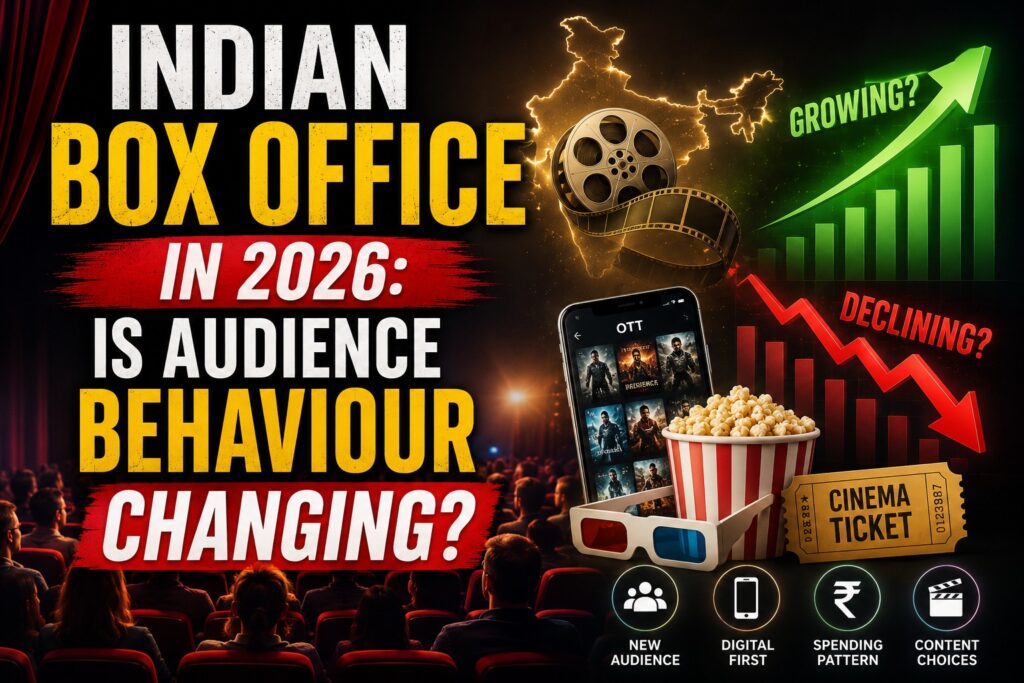
Indian audiences are returning to theatres while exploring films across languages, genres and markets in 2026.
India’s box office has delivered a strong performance in 2026, but the bigger story may be what is happening behind the collection numbers.
The first half of 2026 generated ₹6,398 crore at the Indian box office, up 10% compared with the same period in 2025. More importantly, theatrical footfalls increased by 5% to around 37.8 crore tickets, reversing roughly three years of decline and stagnation.
That raises an important question: Are Indian audiences changing the way they choose films?
The answer appears to be yes.
The change is not necessarily that audiences have stopped caring about stars or big-budget movies. Instead, the 2026 box office suggests that viewers are becoming more selective about which films deserve their time and money.
2026 Is Not Just About Higher Box Office Collections
A growing box office can sometimes be explained by higher ticket prices. But the 2026 numbers point to something more significant.
According to Ormax Media, India’s January-June box office reached ₹6,398 crore, while footfalls rose 5% year-on-year. This means the growth was not simply the result of people paying more for tickets. More people were actually going to cinemas.
Multiplex collections also increased sharply during the first half of the year. The Multiplex Association of India reported a 21% year-on-year increase in multiplex box-office collections in H1 2026.
This suggests that the theatrical market is showing signs of a broader recovery.
But the more interesting question is what audiences are choosing to watch.
Audiences Are Becoming More Selective
The modern Indian moviegoer has more entertainment choices than ever.
A consumer can watch films on OTT platforms, YouTube, social media and other digital services without leaving home.
Going to a cinema therefore requires a stronger reason.
This appears to be pushing audiences towards films that offer either:
- strong entertainment value
- a compelling story
- event-style viewing
- strong word-of-mouth
- popular stars
- a large-scale cinematic experience
- cultural or emotional relevance
The result is a market where audiences may be willing to spend on the right film but increasingly comfortable skipping a film that does not create enough interest.
Star Power Still Matters — But It Is Not Enough
One of the biggest misconceptions about changing audience behaviour is that stars have suddenly become irrelevant.
That is not what the 2026 market indicates.
Star power continues to be an important factor in attracting audiences. However, exhibitors and industry executives have also pointed to the importance of content.
A report from Fortune India noted that exhibitors are seeing films across languages and budgets succeed when audiences find the content compelling. It also highlighted a growing focus on weekday holds and positive word-of-mouth rather than simply looking at opening weekends.
This creates a more complicated equation:
Star power can bring the audience to the theatre.
Content determines whether they stay interested.
Opening Weekend Is No Longer the Entire Story
For years, the opening weekend has been one of the most closely watched indicators of a film’s performance.
That remains important.
However, the 2026 market is also highlighting the importance of what happens after the opening.
A film that receives strong word-of-mouth can maintain occupancy through weekdays and potentially extend its theatrical run.
This is particularly important because the theatrical business is not only about getting people into cinemas on Friday.
The bigger question is:
Can the film continue attracting people after the initial curiosity disappears?
This is where audience satisfaction becomes financially important.
A big opening followed by a sharp drop can produce a very different business outcome from a moderate opening followed by strong weekday performance.
Regional Cinema Is Playing a Bigger Role
Another major change is the increasingly national nature of India’s theatrical audience.
Audiences are no longer necessarily limiting themselves to films produced in their own language.
The first half of 2026 saw successful films across Hindi, Telugu, Tamil, Malayalam, Marathi and international cinema.
Ormax Media reported that Hindi cinema’s share increased to 44% during January-June, while Tamil cinema’s share declined from 17% to 12%.
The July data provided another interesting signal.
International cinema reached a record 17% share of the Indian box office in July, while Hindi cinema’s share fell below 40% for the month.
This does not mean Hindi cinema is losing its importance.
Instead, it shows that the Indian audience pool is becoming more competitive.
A successful film can now come from almost anywhere.
Language Is Becoming Less of a Barrier
The growth of regional cinema has another implication.
Audiences increasingly appear willing to watch films outside their primary language when the film generates enough interest.
Dubbed releases, subtitles, social media conversations and pan-India marketing have reduced some of the traditional barriers between language markets.
For filmmakers, this creates a much larger opportunity.
A Telugu, Tamil, Malayalam, Marathi or Punjabi film no longer has to think only about its traditional regional audience.
The challenge is convincing audiences in other markets that the film is worth watching.
International Films Are Also Competing for Indian Audiences
Hollywood has also demonstrated the growing diversity of the Indian theatrical market.
According to data reported by The Economic Times from Ormax Media, Hollywood films collected around ₹1,424 crore in India during the first seven months of 2026, putting the segment close to its previous annual high of ₹1,595 crore in 2019.
This is another indication that Indian audiences are making viewing decisions based on more than language.
A major international film can compete directly for the same entertainment spending as an Indian release.
That makes the Indian box office increasingly a multi-language and multi-content marketplace.
The Cinema Experience Is Becoming More Important
There is another interesting part of the changing behaviour.
Audiences may be increasingly selective about when they go to theatres, but they can still spend more when the theatrical experience feels worthwhile.
Premium formats such as IMAX and 4DX have benefited from this behaviour.
PVR INOX executives have also pointed to the appeal of premium formats and the continued importance of star-driven films, while noting that Indian audiences are embracing a wider range of genres and international content.
This creates a two-level market.
Some audiences remain price-conscious and may respond to lower weekday pricing.
Others are willing to pay a premium for a major cinematic experience.
Weekday Performance Is Becoming More Important
One of the most useful indicators of changing audience behaviour is the growing attention being paid to weekday performance.
A film that attracts audiences only during the first weekend may have strong initial demand.
But a film that continues to perform on Monday, Tuesday and Wednesday is demonstrating something different:
audience satisfaction.
Strong weekday numbers can indicate that viewers are recommending the film to friends and family, creating additional demand after the initial release.
This makes word-of-mouth increasingly valuable.
For trade analysis, the difference between a film’s opening and its weekday trend can sometimes tell a more useful story than the opening figure alone.
Big Films Still Dominate — But the Market Is Not Completely Concentrated
There is another important contradiction in the 2026 box office.
While audiences are becoming more diverse in their choices, major films still account for a significant portion of the overall business.
Ormax Media reported that six films crossed ₹200 crore during the first half of 2026, compared with four in the same period of 2025.
At the same time, the number of ₹100 crore films fell from 17 to 13.
That suggests the market may be becoming more concentrated around major winners.
In simple terms:
More people are returning to cinemas, but not every film is benefiting equally.
What This Means for Punjabi Cinema
This changing behaviour is particularly relevant for Punjabi cinema.
Punjabi films compete not only with other Punjabi releases but also with Hindi cinema, South Indian films, Hollywood and OTT entertainment.
That makes audience attention more valuable.
A Punjabi film that can generate strong word-of-mouth has an opportunity to hold audiences beyond the opening weekend.
At the same time, the growing willingness of Indian audiences to watch films from different languages creates an opportunity for Punjabi cinema to expand its reach.
The challenge is not simply releasing a Punjabi film in more territories.
The film must give audiences outside Punjab a reason to choose it.
That could come through:
- strong storytelling
- recognisable stars
- music
- comedy
- emotional themes
- cultural identity
- strong reviews
- social media discovery
- diaspora interest
This is where Punjabi cinema’s overseas audience can become particularly important.
Is 2026 Showing a New Indian Moviegoing Pattern?
The available evidence suggests that Indian audiences are not abandoning theatrical cinema.
Instead, they appear to be becoming more selective and more diverse.
The 2026 box office provides several signals:
More footfalls: Ticket sales increased during H1 2026.
More language diversity: Successful films are coming from multiple Indian language industries.
Stronger international competition: Hollywood has recorded a major year in India.
Greater importance of word-of-mouth: Weekday performance is receiving increased attention from exhibitors.
Premium cinema remains attractive: Audiences continue to pay for enhanced theatrical experiences when the film justifies it.
Together, these trends suggest that Indian moviegoing is becoming less predictable.
The Bigger Box Office Lesson
The biggest lesson from 2026 may not be that Indian cinema is simply recovering.
It may be that audience choice is becoming more powerful.
A star can create awareness.
A large marketing campaign can create an opening.
A major franchise can create anticipation.
But sustained theatrical performance increasingly depends on whether audiences believe the film is worth recommending and worth paying for.
That makes the future box office less about simply producing bigger films and more about understanding what audiences consider an experience worth leaving home for.
Conclusion
Indian cinema’s 2026 box office suggests that audience behaviour is changing, but not in a simple way.
People are returning to theatres, with footfalls rising after years of stagnation. At the same time, audiences are exploring more languages, international films and different genres.
The theatrical market is therefore not disappearing because of OTT.
Instead, it appears to be becoming more selective.
For the Indian film industry — including Punjabi cinema — the opportunity is clear: make the theatrical experience feel valuable enough for audiences to choose it over everything else competing for their attention.
The films that understand that equation may have the strongest advantage in the years ahead.
Disclaimer
Box-office figures and industry estimates can vary between trade sources, measurement agencies and reporting periods. Figures cited in this article are attributed to the respective sources and should be treated as reported industry data or estimates rather than independently audited figures. Box-office performance can also change as films continue their theatrical runs.