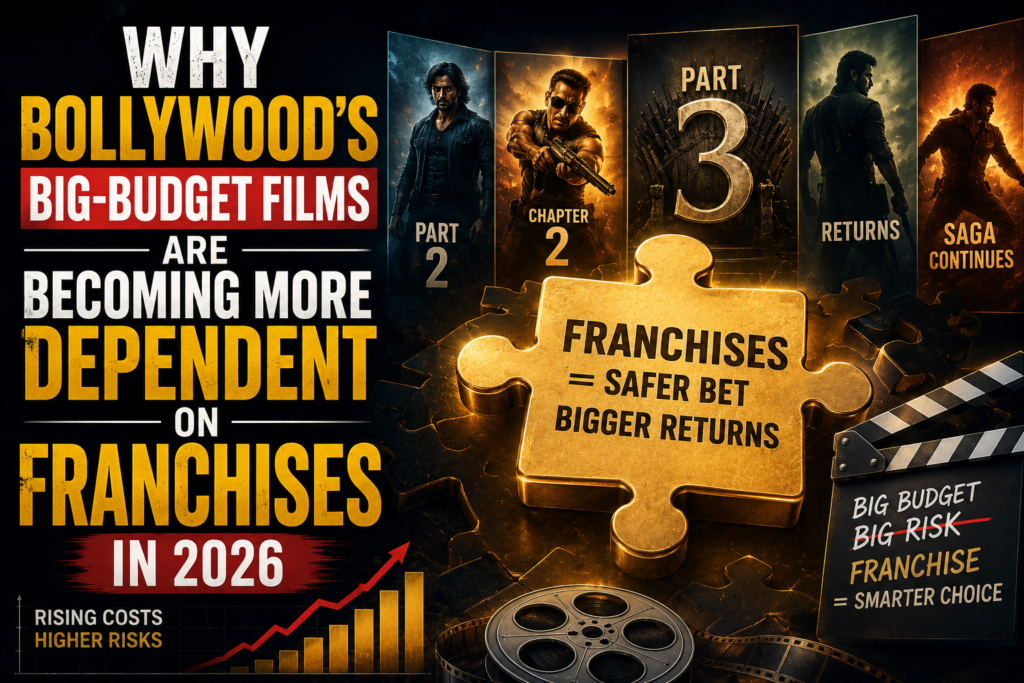
Bollywood Franchises, Sequels and Big-Budget Films Are Reshaping the Hindi Box Office in 2026
Bollywood’s theatrical business is entering a more selective phase in 2026.
The Hindi film industry continues to produce large-scale entertainers, star-driven projects and expensive action films, but the commercial environment has changed. A high production budget no longer guarantees a large theatrical audience.
This is increasing the value of something that studios cannot manufacture overnight: existing audience recognition.
Franchises, sequels, established characters and familiar cinematic properties are increasingly important because they give audiences an immediate reason to understand and notice a film.
That does not mean original Bollywood cinema has lost its value. It means the financial risk attached to launching an entirely new theatrical property has become harder to manage.
The Franchise Advantage
A franchise begins with something an original film does not have: familiarity.
When audiences have already seen previous instalments, they understand the characters, tone and basic promise of the next film.
That familiarity can help create:
- Early trailer interest
- Social-media conversation
- Advance bookings
- Opening-weekend demand
- Media coverage
- Overseas awareness
The franchise itself becomes part of the marketing campaign.
For a new film, the marketing team first has to explain what the film is.
For a successful franchise, the audience may already know.
That difference can be commercially significant.
Why Big Budgets Create Bigger Risks
The biggest issue is not simply that Bollywood films are expensive.
It is that a larger budget increases the level of theatrical performance required to justify the investment.
A film costing significantly more needs a much larger revenue opportunity across theatrical, overseas, digital, satellite, music and other rights.
This creates a difficult situation for original films.
If audiences are uncertain about the concept, the studio may have to spend heavily on marketing before release.
The film therefore carries two major expenses:
High production cost + high audience-acquisition cost.
A franchise can potentially reduce some of that uncertainty because its brand recognition already exists.
Stars Still Matter — But Their Role Is Changing
Star power remains one of Bollywood’s most important commercial assets.
A major actor can generate awareness that a lesser-known cast may struggle to create.
But the relationship between stars and box office is becoming more complicated.
Audiences increasingly evaluate the film and the star together.
A major actor in an established franchise can create a stronger commercial proposition than the same actor in an unfamiliar property.
This means the modern equation is increasingly:
Star + Franchise + Genre + Marketing + Release Date
rather than simply:
Star = Box Office
That distinction is important when evaluating the economics of expensive Hindi films.
Sequels Have a Built-In Marketing Story
A sequel does not need to introduce its entire world again.
The first film has already created an audience vocabulary.
Characters may already be recognizable.
Catchphrases, music, locations or visual identities may already have cultural recognition.
Even when a sequel changes its story, the established identity can provide a promotional advantage.
However, there is an important limitation.
A franchise can create an opening, but it cannot guarantee audience satisfaction.
If viewers feel that a sequel does not justify its existence, negative word of mouth can spread rapidly.
The franchise advantage is therefore strongest when the new film delivers what audiences expect while offering something new.
The Opening Weekend Has Become Critical
Big-budget Hindi films operate under significant theatrical pressure.
A major release can generate enormous attention during its first weekend, but exhibitors and distributors quickly begin evaluating audience demand.
The first few days provide important information about:
- Advance booking
- Occupancy
- Audience response
- Show utilisation
- Multiplex demand
- Single-screen performance
- City-level differences
- Overseas response
A strong opening gives a film breathing room.
A weak opening can make recovery significantly more difficult, particularly when the film has a large cost base.
This is why franchise recognition has become strategically valuable.
It can increase the probability of getting a larger initial audience.
But Franchise Fatigue Is a Real Risk
The growing importance of franchises creates another problem.
If studios depend too heavily on sequels, audiences can eventually become less interested.
Repeated instalments can lose their novelty.
The commercial value of a franchise depends on maintaining audience trust.
A weak sequel can damage the value of the next instalment.
This creates a long-term challenge for studios:
How do you expand a franchise without exhausting it?
The answer is not simply more sequels.
It is stronger writing, meaningful character development and a reason for audiences to return.
Original Films Face a Different Challenge
An original Hindi film has to establish itself from the beginning.
Audiences may not know the characters.
They may not understand the concept.
The trailer has to communicate the film quickly.
The marketing campaign must create curiosity.
And the cast has to convince viewers that the theatrical experience is worth their time.
This makes original films particularly dependent on concept strength.
A genuinely distinctive concept can become its own franchise.
But the first film carries the greatest risk because there is no previous box-office history to rely on.
Social Media Has Changed the Risk Equation
The modern audience does not wait several days before forming an opinion.
Trailers, songs, teasers and promotional clips can generate immediate reactions.
Once the film releases, reviews and audience reactions spread rapidly.
This has two consequences.
Positive word of mouth can help a film expand beyond its initial audience.
Negative reactions can reduce demand just as quickly.
Franchises therefore enter the market with an advantage, but their previous reputation also creates expectations.
If expectations are not met, the backlash can be stronger.
Music Still Plays a Major Role
Music remains an important promotional tool for Bollywood.
A successful song can provide a film with months of audience exposure before release.
Songs can circulate through:
- YouTube
- Short-form video platforms
- Music streaming services
- Radio
- Live performances
For franchise films, familiar musical themes can further strengthen recognition.
However, music popularity and theatrical success are not identical.
A viral song can generate awareness, but the film still has to convert that awareness into cinema attendance.
Overseas Markets Add Another Layer
Bollywood’s commercial geography extends well beyond India.
The UK, North America, the Middle East, Australia and other international territories contribute to the theatrical business of Hindi cinema.
For large-scale films, overseas performance can become an important part of the overall recovery equation.
Franchise recognition can also travel internationally.
Audiences who are familiar with a Hindi film property through previous instalments may be easier to reach with the next release.
But overseas markets are not automatic safety nets.
Distribution costs, competition, local audience behaviour, exchange rates and release timing all affect international performance.
OTT Has Changed the Value of a Film
Theatrical revenue is no longer the only commercial consideration.
Hindi films can generate value through digital rights, satellite rights, music and other licensing arrangements.
OTT has therefore become an important component of the broader film business.
But digital availability has also changed audience behaviour.
Some viewers are willing to wait for streaming rather than immediately visit a cinema.
This creates a challenge for theatrical films.
The movie has to offer enough urgency, scale or entertainment value to convince audiences that watching it in a cinema is worthwhile.
Large franchises can sometimes create this urgency through event positioning.
Why “Big Budget” Is Not the Same as “Big Event”
One of the most important distinctions in today’s Bollywood market is between a big-budget film and a big theatrical event.
A film can spend heavily on production without becoming an event.
An event film requires:
- Audience awareness
- Strong positioning
- Marketing visibility
- Star recognition
- Trailer response
- Music or cultural conversation
- Suitable release timing
- Strong exhibition support
Budget can improve the scale of the experience.
It cannot automatically create demand.
This is why producers increasingly need to think about audience perception before deciding how much money to spend.
Release Date Can Change the Economics
A franchise film can still struggle if it arrives in an overcrowded release window.
Theatrical screens are limited.
Audiences have limited time and budgets.
Competing Hindi releases, regional films and Hollywood titles can all affect screen availability.
A strategically chosen release date can therefore provide a major advantage.
The opposite is also true.
A film released into an extremely competitive period may struggle even if the product itself is strong.
What Bollywood Can Learn From the Current Market
The industry’s increasing reliance on franchises is not simply a trend toward sequels.
It reflects a broader change in risk management.
Studios are looking for properties that already have:
Audience recognition + marketing value + distribution potential + future expansion opportunities.
This is why established characters and cinematic universes are becoming increasingly valuable.
But there is another lesson.
The safest investment is not always the biggest franchise.
A controlled-budget original film with strong content can potentially deliver better economics than an expensive sequel that fails to meet audience expectations.
The objective should therefore be risk-adjusted box-office performance, not simply the largest opening possible.
What This Means for Bollywood in 2026
The Hindi film industry is likely to continue producing both original films and franchise projects.
The difference is that franchises may receive greater strategic importance when studios evaluate large theatrical investments.
For audiences, this can mean more sequels, spin-offs and connected properties.
For filmmakers, it creates an opportunity to build new intellectual properties that can eventually become franchises themselves.
For producers, the challenge will be controlling costs while creating films that feel sufficiently important to justify a theatrical visit.
And for exhibitors, the focus will remain on films capable of generating sustained demand rather than simply opening strongly.
Final Trade Outlook
Bollywood’s increasing dependence on franchises in 2026 is ultimately a response to uncertainty.
Theatrical audiences have more entertainment choices.
Production costs can be substantial.
Marketing competition is intense.
OTT provides an alternative viewing option.
And audience reactions can spread almost instantly.
In that environment, familiarity becomes valuable.
But familiarity alone cannot save a weak film.
The long-term winners will likely be franchises that continue to evolve, stars who choose projects carefully, and original films capable of creating their own audience identities.
The real objective for Bollywood is therefore not to make more sequels simply because sequels are safer.
It is to create films where budget, audience expectation, franchise value and theatrical potential are aligned.
That balance could become one of the defining commercial challenges for Hindi cinema through the remainder of 2026.