
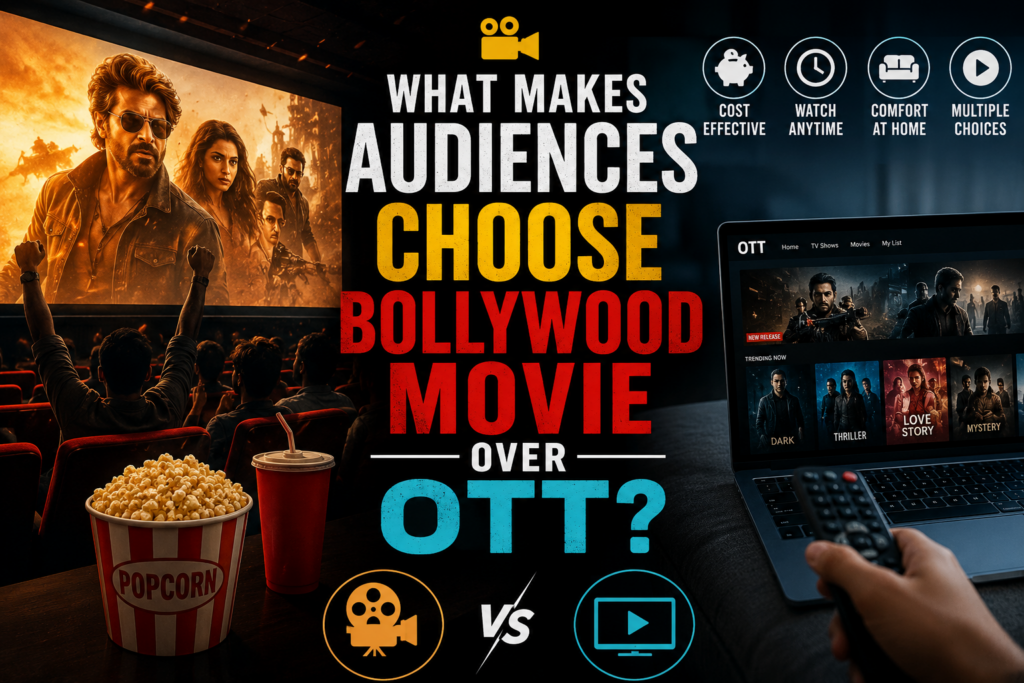
Why do audiences still choose theatres when Bollywood movies eventually arrive on OTT? An analysis of the factors driving theatrical viewing in 2026.
The rise of streaming platforms has fundamentally changed how audiences consume Bollywood films. Viewers can now watch thousands of movies from their homes, often without waiting too long after a theatrical release.
Yet cinemas continue to attract audiences.
The important question for the Bollywood film business is no longer simply whether people watch movies. It is why they decide to leave home, buy a ticket and watch a particular film in a theatre when they know it may eventually become available on OTT.
The answer is not one-dimensional.
For some films, the theatrical experience offers something that a television or mobile screen cannot reproduce. For others, audiences may prefer to wait for streaming.
This distinction is becoming increasingly important for producers, distributors, exhibitors and marketers planning Bollywood releases.
The Theatre and OTT Offer Different Experiences
The simplest way to understand the difference is that theatres sell an experience, while OTT primarily sells convenience and flexibility.
A cinema visit involves:
- Travelling to a theatre
- Buying a ticket
- Watching the film on a large screen
- Experiencing surround sound
- Sharing the experience with other viewers
- Spending time outside the home
OTT offers a very different proposition:
- Watch from home
- Choose your viewing time
- Pause or resume
- Watch on multiple devices
- Avoid travel
- Access a large content library
Neither model is automatically better.
The decision depends on the movie and what the audience expects from it.
Spectacle Can Give Theatres an Advantage
Large-scale Bollywood films are often designed around elements that benefit from theatrical presentation.
These can include:
- Action sequences
- Large-scale visuals
- Dance numbers
- Detailed production design
- High-end sound
- Visual effects
- Large-format cinematography
When audiences believe that a movie will provide a significantly better experience on a large screen, the incentive to visit a theatre becomes stronger.
This is particularly relevant for films marketed as cinematic events.
Star Power Still Influences the Decision
Actors remain an important factor in theatrical decision-making.
A major star can create familiarity before the audience knows much about the story.
However, star power alone does not guarantee sustained theatrical success.
Audiences increasingly consider:
- The actor’s recent track record
- The director
- The trailer
- Reviews
- Word of mouth
- Genre
- Story concept
Star power can encourage an opening, but the movie itself usually determines whether audiences continue coming.
The Social Experience Matters
Going to the movies can also be a social activity.
Friends, couples and families may choose a theatre because watching a film together is part of the experience.
This is particularly relevant for:
- Family entertainers
- Comedy films
- Action movies
- Event releases
- Major franchises
The laughter, reactions and atmosphere inside a packed auditorium can become part of the entertainment.
That experience is difficult to completely reproduce at home.
The Right Content Can Create Urgency
One of the biggest differences between theatrical and OTT consumption is urgency.
A movie available only in theatres creates a limited window.
Audiences may think:
“If I don’t watch it now, I’ll have to wait.”
This creates a sense of urgency that can encourage ticket purchases.
When a movie is immediately perceived as an OTT-oriented title, audiences may be more comfortable waiting.
Reviews and Word of Mouth Can Change the Decision
Modern audiences have access to enormous amounts of information before buying a movie ticket.
They can see:
- Trailer reactions
- Audience reviews
- Social media discussions
- Critics’ opinions
- Box office trends
- Friends’ recommendations
Positive word of mouth can convert undecided viewers into theatre audiences.
Negative reactions can have the opposite effect.
This is why the period immediately after release is extremely important.
Ticket Pricing Has Become More Important
Price is another major factor.
For a family, the cost of a theatrical outing can include:
- Multiple tickets
- Food and beverages
- Parking
- Transportation
Compared with watching a film at home, a cinema trip can therefore represent a much larger entertainment expense.
This makes pricing strategy increasingly important.
Special offers, discounted tickets and strategically priced shows can reduce the barrier for price-sensitive audiences.
Premium Formats Create Another Reason to Visit
Premium cinema formats can strengthen the theatrical proposition.
Large screens, advanced sound systems and premium seating can make audiences feel that they are purchasing something different from a standard home-viewing experience.
For films that rely heavily on spectacle, premium presentation can become part of the marketing strategy.
Release Timing Can Influence Audience Behaviour
The timing of a Bollywood release can also affect whether audiences choose theatres.
A film released during:
- Major holidays
- Festival periods
- School vacations
- Long weekends
may benefit from increased leisure time.
Families and groups often have more opportunities to plan outings during these periods.
However, competition can also become stronger during major release windows.
Marketing Must Sell the Theatre Experience
Traditional movie marketing often focused on simply telling audiences that a film was coming.
Modern campaigns increasingly need to answer another question:
Why should I watch this film in a theatre?
Trailers and promotional campaigns can emphasize:
- Scale
- Action
- Music
- Visual effects
- Comedy
- Emotional experience
- Audience reactions
The marketing message therefore becomes part of the theatrical value proposition.
Franchises Have an Important Advantage
Established franchises can create stronger theatrical urgency because audiences already know the characters and world.
A successful franchise can benefit from:
- Existing fan communities
- Familiar characters
- Established brand identity
- Stronger opening-day awareness
- Social media anticipation
However, franchises also carry higher audience expectations.
A recognizable name can bring people to the theatre, but the film still has to deliver.
Bollywood’s Competition Is No Longer Just Other Movies
The modern Bollywood audience has more entertainment choices than ever.
A movie competes not only with another theatrical release but also with:
- OTT platforms
- Web series
- YouTube
- Short-form video
- Gaming
- Social media
- International films
- Regional cinema
This means theatrical films need a clear reason for audiences to prioritize them.
What Makes a Bollywood Movie More Theatrical?
There is no universal formula, but several factors can increase theatrical appeal.
| Factor | Why It Matters |
|---|---|
| Spectacle | Benefits from a large screen |
| Strong Reviews | Builds confidence |
| Star Power | Creates initial awareness |
| Franchise Value | Generates familiarity |
| Music | Builds emotional connection |
| Social Experience | Encourages group viewing |
| Event Positioning | Creates urgency |
| Good Pricing | Reduces barriers |
| Word of Mouth | Sustains demand |
| Release Timing | Creates viewing opportunities |
The strongest theatrical performers often combine several of these elements rather than relying on just one.
Why Some Films Are Better Suited to OTT
Not every Bollywood film needs to be positioned as a major theatrical event.
Some movies may naturally work better on streaming because their appeal is based on:
- Intimate storytelling
- Slow-burn narratives
- Niche subjects
- Limited target audiences
- Smaller production scales
For such projects, OTT can provide access to audiences that might not have been large enough to support an extensive theatrical run.
This does not necessarily mean the film has failed.
It means the film may have a different commercial model.
Theatrical and OTT Can Work Together
The relationship between theatres and streaming platforms is increasingly becoming complementary rather than purely competitive.
A film can have different objectives at different stages:
Theatrical release → Box office revenue → Audience awareness → OTT release → Long-term streaming audience
The theatrical window can create cultural visibility, while OTT can extend the film’s life.
For producers, this means the question isn’t always theatre or OTT.
It can be how theatrical and OTT work together.
What This Means for Bollywood Producers
Producers increasingly need to evaluate the theatrical potential of a film before deciding its release strategy.
Important questions include:
- Who is the target audience?
- Does the film benefit from a large screen?
- Is the cast commercially recognizable?
- Does the trailer create urgency?
- Is the release date advantageous?
- Can marketing communicate a clear theatrical reason?
- Does the film have franchise or event value?
Answering these questions can help determine the most appropriate distribution strategy.
The Future of Bollywood’s Theatrical Audience
The future is unlikely to be a simple battle between theatres and OTT.
Instead, audiences will probably become more selective.
They may visit theatres for films that offer:
Experience + Scale + Social Value + Urgency
And choose OTT for films that offer:
Convenience + Flexibility + Discovery + Comfort
This means Bollywood’s theatrical future will depend on creating movies that audiences genuinely believe are worth leaving home for.
Conclusion
The biggest advantage theatres have over OTT is not simply a larger screen. It is the complete experience surrounding a film.
A major Bollywood release can become an event involving friends, family, music, spectacle, anticipation and audience reactions. When those elements come together, audiences have a reason to buy a ticket even when they know the film will eventually arrive on a streaming platform.
At the same time, OTT has permanently changed audience expectations. Viewers are more selective, more informed and more comfortable waiting for films that do not offer a compelling theatrical experience.
For Bollywood, the future therefore lies not in choosing between theatres and OTT, but in understanding which films deserve a theatrical experience and what makes audiences believe that experience is worth paying for.





1 thought on “What Makes Audiences Choose a Bollywood Movie Over OTT?”