

What Is the Difference Between India Net, Gross and Worldwide Collection?
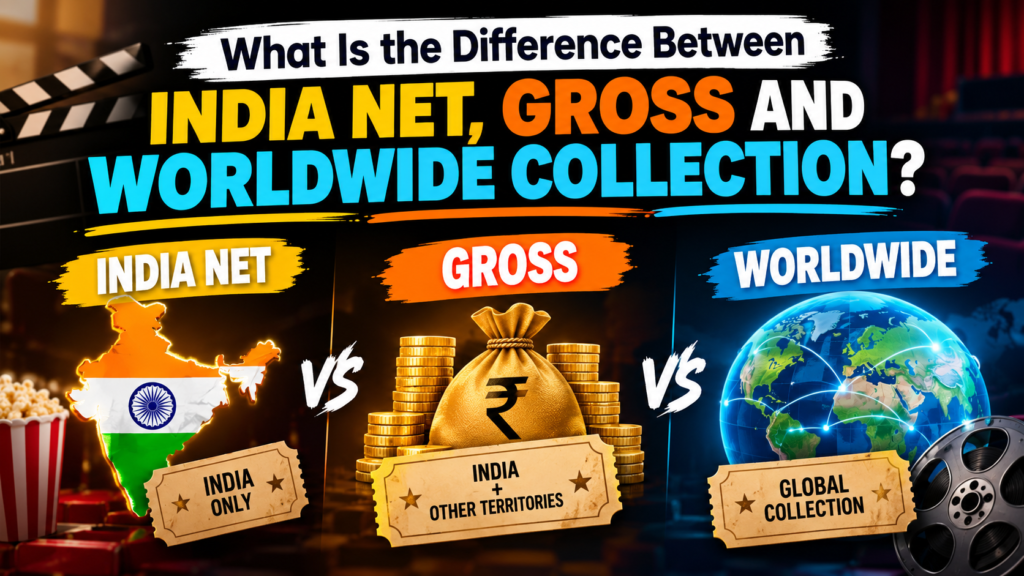
Understanding the difference between India Net, India Gross and Worldwide Box Office Collection.
When a movie’s box-office numbers are reported, readers often come across terms such as India Net Collection, India Gross Collection and Worldwide Collection. These numbers can look similar, but they measure different things.
Understanding the difference is important because a film can have a large worldwide collection while its India net collection is comparatively lower. Similarly, two films with similar gross collections may have different net figures depending on taxes and market performance.
So, what do these terms actually mean?
This guide explains India Net, India Gross and Worldwide Collection in simple language and shows how they are connected.
What Is India Net Collection?
India Net Collection generally refers to the amount a movie earns at the Indian box office after applicable entertainment taxes are deducted from the gross box-office receipts.
In simple terms:
India Gross − Applicable Taxes = India Net
For example, suppose a film generates ₹10 crore in gross theatrical revenue in India.
If ₹1.8 crore represents applicable taxes, the reported India net collection would be approximately:
₹10 crore − ₹1.8 crore = ₹8.2 crore net
The exact calculation can vary depending on the applicable tax structure and reporting methodology.
India net is one of the most commonly discussed figures in Indian box-office reporting because it is widely used when comparing domestic theatrical performance.
What Is India Gross Collection?
India Gross Collection refers to the total theatrical box-office receipts generated by a movie in India before applicable taxes are removed.
For example:
India Gross = ₹10 crore
If taxes account for ₹1.8 crore, the corresponding net figure would be approximately:
India Net = ₹8.2 crore
Therefore, gross and net are not interchangeable terms.
A headline saying a film earned ₹10 crore gross in India does not necessarily mean that the film’s India net collection was also ₹10 crore.
India Net vs India Gross: The Simple Difference
The easiest way to remember the difference is:
| Term | What it generally represents |
|---|---|
| India Net | Indian theatrical collection after applicable taxes |
| India Gross | Indian theatrical collection before applicable taxes |
| Worldwide Gross | Combined theatrical gross from India and overseas markets |
This distinction becomes particularly important when reading box-office reports for major releases.
What Is Worldwide Collection?
Worldwide Collection generally refers to the combined theatrical gross generated by a film across India and international markets.
A simplified formula is:
Worldwide Gross = India Gross + Overseas Gross
For example, imagine a movie records:
- India Gross: ₹80 crore
- Overseas Gross: ₹20 crore
Its approximate worldwide gross would be:
₹80 crore + ₹20 crore = ₹100 crore
This does not mean the movie earned ₹100 crore as India net.
The worldwide figure includes performance from markets outside India.
Why Does Overseas Collection Matter?
Indian films are released in many international markets. Depending on the film, important overseas territories can include countries and regions such as the United States, Canada, United Kingdom, Australia, the Middle East and other international markets.
For Punjabi cinema in particular, overseas markets can be especially important because Punjabi films have audiences among the global Punjabi diaspora.
This means a film’s domestic Indian performance does not always tell the complete story of its theatrical reach.
A movie may have moderate India collections but a relatively strong overseas contribution.
A Simple Example
Consider a fictional movie called Movie A.
Suppose its reported theatrical performance is:
India Gross: ₹50 crore
Applicable taxes: ₹9 crore
India Net: ₹41 crore
Overseas Gross: ₹14 crore
Its approximate worldwide gross would be:
₹50 crore + ₹14 crore = ₹64 crore
So the three figures tell different parts of the story:
₹41 crore → India Net
₹50 crore → India Gross
₹64 crore → Worldwide Gross
This is why simply looking at one number can sometimes create confusion.
Why Is India Net Often Used for Domestic Comparisons?
India net collection is commonly used in Indian box-office discussions because it provides a standardized domestic figure after applicable taxes.
This is why box-office reports often use phrases such as:
- Opening day India net
- Weekend India net
- Week 1 India net
- Total India net
- India net lifetime collection
However, the exact methodology used by different box-office trackers can vary.
Readers should therefore pay attention to whether a report is describing net, gross, distributor share or another financial metric.
Does Worldwide Collection Mean the Movie Made That Much Profit?
No.
This is one of the most important things to understand about box-office numbers.
A movie’s worldwide gross is not the same thing as its profit.
The money generated at cinemas is distributed among different participants in the theatrical ecosystem. Depending on the market and agreement, this can involve exhibitors, distributors, producers and other parties.
A film also has costs such as:
- Production
- Star remuneration
- Marketing
- Distribution
- Financing
- Interest and other expenses
Therefore:
Worldwide Gross ≠ Producer Profit
A movie can have a large worldwide collection and still have a complicated profitability picture.
What Is Distributor Share?
Another term readers may encounter is distributor share.
Distributor share is different from both India net and worldwide gross.
A simplified way to understand the relationship is:
Audience spends money on tickets → Cinema earns its share → Distributor receives its contracted share → Producer’s economics depend on the film’s overall business arrangement
The actual financial structure can vary by film, territory, distributor and agreement.
This is why box-office collection alone cannot always determine whether a movie is financially successful.
Can Two Movies With the Same Worldwide Collection Have Different Results?
Yes.
Imagine two films both report approximately ₹100 crore worldwide gross.
Movie A has:
- ₹90 crore from India
- ₹10 crore overseas
Movie B has:
- ₹55 crore from India
- ₹45 crore overseas
Both may have the same approximate worldwide gross, but their market performance is very different.
The second movie has a much larger overseas contribution.
This distinction can be particularly useful when analysing Punjabi films because overseas audiences can represent an important part of a film’s theatrical business.
Why Box-Office Numbers Can Differ Between Sources
Readers may sometimes notice that two websites report slightly different figures for the same film.
There can be several reasons:
1. Different reporting times
One tracker may update its figure earlier than another.
2. Estimates
Daily box-office figures are often initially reported as estimates before more complete data becomes available.
3. Different methodologies
Different trade trackers may use different approaches to calculate or compile collections.
4. Territory reporting
Some reports may include or exclude particular markets depending on the source.
5. Gross vs net confusion
A figure labelled “collection” without clearly identifying whether it is net or gross can easily lead to misunderstandings.
For this reason, readers should always check what the number represents before comparing it with another figure.
India Net, India Gross and Worldwide: Quick Comparison
Here is the easiest way to remember the three terms:
India Net
Money collected theatrically in India after applicable taxes.
India Gross
Total theatrical collection in India before applicable taxes.
Worldwide Gross
Combined theatrical gross from India and overseas markets.
In simplified form:
India Net < India Gross
And:
Worldwide Gross = India Gross + Overseas Gross
The exact reported figures can vary according to the source and reporting methodology.
Which Number Should You Look At?
It depends on what you want to understand.
Want to compare domestic Indian performance?
Look at India net, while checking that the figures use a consistent methodology.
Want to understand total Indian theatrical business before taxes?
Look at India gross.
Want to understand a movie’s overall theatrical reach across markets?
Look at worldwide gross along with the India and overseas split.
Want to know whether a movie is profitable?
Do not rely on worldwide collection alone. You also need information about the movie’s budget, distribution arrangements, rights revenue and other business factors.
Why This Matters for Punjabi Cinema
For Punjabi cinema, box-office analysis becomes more interesting when domestic and overseas performance are considered together.
Punjabi films can have audiences in Punjab and other parts of India while also attracting viewers in international markets with established Punjabi-speaking communities.
As a result, India collection and worldwide collection can tell different stories about the same film.
A movie with strong overseas demand may have a larger worldwide contribution from international markets, while another film may depend primarily on its Indian theatrical performance.
This is why serious box-office analysis should look beyond a single headline number.
Buy Branded Buy Neonwale NEON LIGHTS
Pollywood Box Office News Network





1 thought on “What Is the Difference Between India Net, Gross and Worldwide Collection?”