

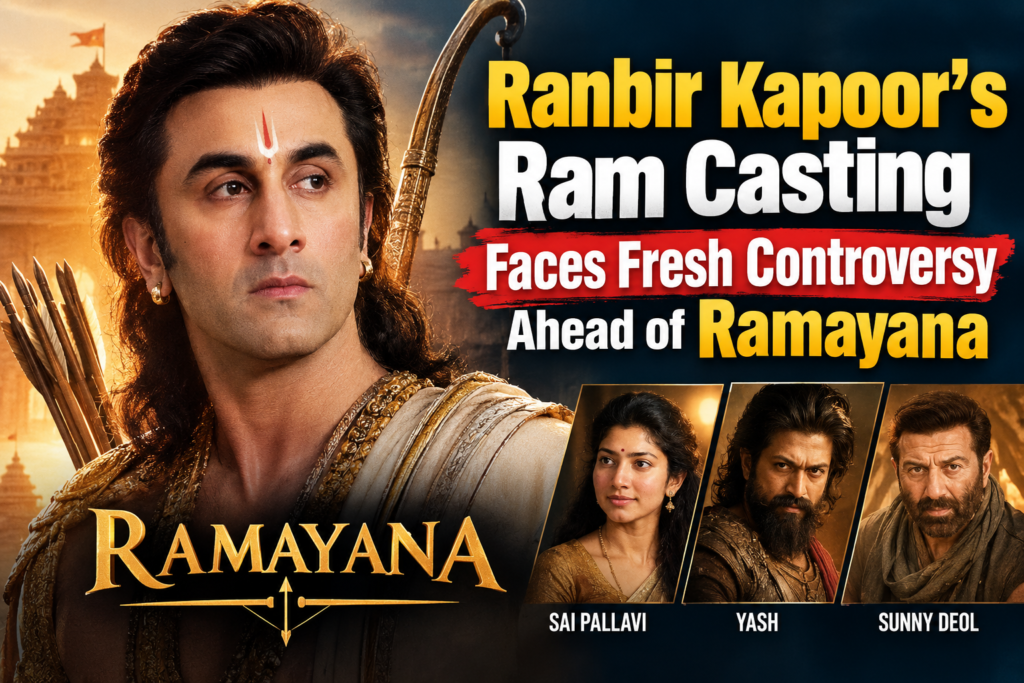
Ranbir Kapoor’s casting as Lord Ram in Ramayana has sparked fresh discussion among audiences.
Ranbir Kapoor’s casting as Lord Ram in Nitesh Tiwari’s much-awaited Ramayana has once again become a subject of discussion. While the film has generated considerable anticipation because of its scale, star cast and visual ambition, questions surrounding the choice of Ranbir for the central role have resurfaced following recent comments from Shiv Sagar, grandson of legendary filmmaker Ramanand Sagar.
The project is based on one of India’s most culturally significant epics, making the casting of its principal characters a sensitive subject for audiences.
Shiv Sagar Questions Ranbir Kapoor’s Casting
Shiv Sagar, whose grandfather Ramanand Sagar created the iconic television series Ramayan, has expressed reservations about Ranbir Kapoor portraying Lord Ram.
According to recent reports, Shiv Sagar acknowledged Ranbir’s abilities as an actor but said he personally found it difficult to accept him as Lord Ram because of the image associated with some of his previous roles.
His comments specifically brought Ranbir’s Animal image into the discussion. The concern is that audiences may carry memories of the actor’s previous characters into a role that requires a very different emotional and cultural interpretation.
Shiv Sagar also suggested that a relatively fresh face could have been considered for such a significant mythological character.
The remarks have added another layer to an already ongoing conversation around the film’s casting.
Why Ranbir’s Casting Has Become Such a Big Talking Point
Casting a major Bollywood star in a mythological role can work in two ways.
On one side, Ranbir Kapoor brings considerable audience recognition and commercial value. His presence can help a large-scale film attract attention across different markets and demographics.
On the other side, Lord Ram is a character with an established cultural image in the minds of Indian audiences. Unlike an entirely fictional character, the expectations surrounding the portrayal are shaped by religious traditions, literature, television adaptations and generations of storytelling.
This makes the casting discussion much broader than simply asking whether an actor is talented enough for a role.
The question is also about whether audiences can separate an actor from his previous screen image and accept him within a deeply familiar mythological character.
Ranbir Kapoor Had Earlier Addressed the Debate
Interestingly, Ranbir Kapoor himself has previously responded to questions about his casting as Lord Ram.
During discussions around the film, the actor said that there could never be a single “right” actor to play Rama. His position essentially highlighted the challenge of portraying a character who has been represented in different forms across generations.
That statement is important because the debate is unlikely to disappear simply because the film has been completed.
For the makers, the real test will be whether the final performance convinces audiences once they experience the complete film rather than judging the casting only through promotional material.
Ramayana Has a High-Profile Ensemble
The film’s casting has been designed on a very large scale.
Ranbir Kapoor plays Lord Ram, while Sai Pallavi portrays Sita and Yash plays Ravana. Sunny Deol is associated with the role of Hanuman, adding another major star to the ensemble.
The combination of Bollywood and South Indian stars is also expected to give the film a wider national appeal.
Yash’s presence as Ravana, in particular, has generated considerable interest among audiences in the South as well as Hindi-speaking markets.
This gives Ramayana an unusual commercial structure: it is being positioned not simply as a Hindi-language star vehicle but as a large-scale pan-Indian event film.
The Animal Factor in the Casting Debate
The biggest argument surrounding Ranbir’s casting is arguably not his acting ability but the contrast between his previous screen image and Lord Ram.
Animal presented Ranbir in an intense and morally complicated role that became one of the most discussed performances of his career.
For some viewers, that association has created difficulty in immediately accepting him as Rama.
However, actors regularly move between radically different characters. From a purely cinematic perspective, an actor’s previous role does not necessarily determine his ability to portray another character.
The question is whether the audience is willing to make that separation.
That answer will ultimately come through the film itself.
The Film’s Scale Could Shift the Conversation
The casting debate is taking place alongside another major discussion around Ramayana: its visual effects and overall scale.
The film has been positioned as a major cinematic interpretation of the epic, with extensive visual-effects work and international technical involvement. After promotional material was released, some viewers questioned aspects of the VFX, while the film’s team defended the scale and complexity of the production.
For a project of this size, the audience’s final response will therefore depend on multiple factors.
Casting will be one part of the equation, but storytelling, performances, music, visual effects, emotional impact and the treatment of the source material will all influence the film’s reception.
What This Means for Ramayana’s Box Office Prospects
From a trade perspective, the controversy itself is unlikely to be the deciding factor for the film’s theatrical performance.
In fact, continued discussion around Ranbir’s casting keeps the project in the public conversation months before its theatrical release.
The bigger question is whether Ramayana can convert this awareness into strong theatrical demand.
The film has several commercial advantages: a recognised lead actor, a major South Indian star, a familiar story, large-scale production values and significant national curiosity.
At the same time, expectations are exceptionally high.
Because the story is already deeply familiar to Indian audiences, the film cannot rely only on novelty. The execution will have to provide a compelling cinematic experience while maintaining sensitivity toward the source material.
Audience Response Will Be the Final Test
The latest comments have once again placed Ranbir Kapoor’s casting at the centre of the Ramayana conversation.
But it is important to distinguish between an individual’s opinion and the eventual response of the wider audience.
Shiv Sagar’s comments represent one perspective on the casting. Other members of the film’s team and cast have expressed confidence in the project and in Ranbir’s portrayal.
Ultimately, the audience will decide whether Ranbir Kapoor can successfully transition from his established Bollywood image into one of India’s most revered mythological characters.
For Ramayana, that acceptance could become one of the most important factors in determining whether the film’s enormous scale translates into an equally strong theatrical response.
Conclusion
Ranbir Kapoor’s casting as Lord Ram has once again triggered debate, this time following strong reservations from Ramanand Sagar’s grandson Shiv Sagar.
The controversy highlights the unique challenge of adapting the Ramayana for modern cinema. The film has to satisfy audiences who expect spectacle while also respecting a story and characters that carry deep cultural significance.
For the makers, the real answer will not come from social-media debates or individual opinions. It will come when audiences watch the complete film and decide whether Ranbir Kapoor has successfully made Lord Ram his own while remaining faithful to the expectations surrounding the character.
Until then, the casting debate is likely to remain an important part of the Ramayana conversation.