

Punjabi Box Office: How Movie Collections Are Calculated
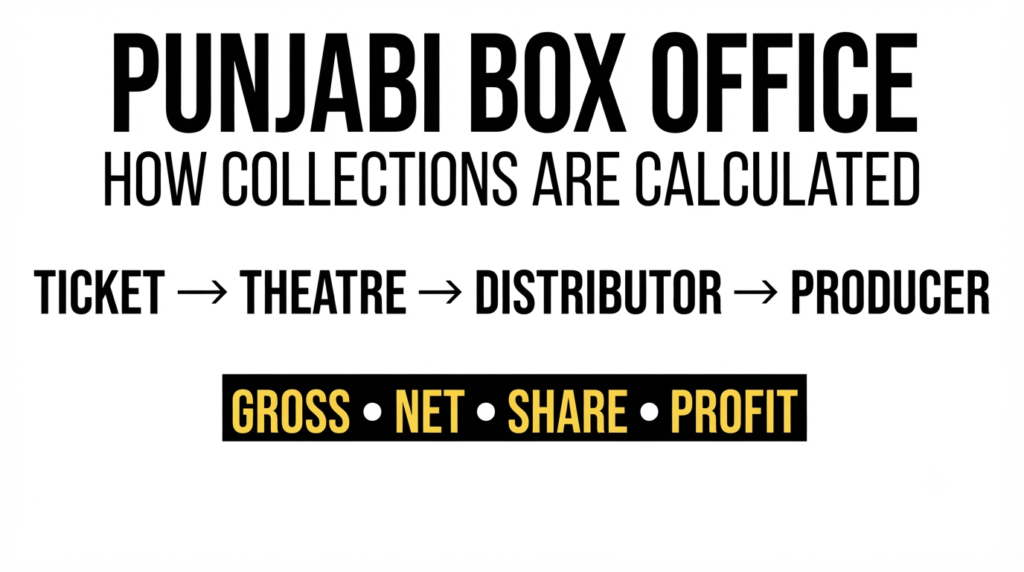
How Punjabi movie box office collections are calculated: from ticket sales to gross, net, distributor and theatre share.
When a Punjabi movie is reported as earning ₹5 crore, ₹10 crore or ₹50 crore at the box office, the figure does not mean that the producer receives the same amount.
A movie’s theatrical business involves ticket sales, taxes, exhibitors, distributors and producers, and the amount reported as a box-office collection can represent different stages of that business.
For readers following Punjabi cinema, understanding these terms is important because gross collection, net collection and distributor share are not the same thing.
This guide explains how Punjabi box-office numbers are generally calculated, what different collection terms mean, why trade estimates can differ and how a film’s theatrical revenue eventually reaches different participants in the distribution chain.
Important: Box-office reporting is not always based on one publicly available central database. Figures reported by trade sources can be estimates, while audited settlement figures may be available only to industry stakeholders. PBO should therefore use terms such as “trade estimate” or “according to available trade data” when an official audited figure is unavailable.
What Is Box Office Collection?
Box office collection generally refers to the money generated through the theatrical sale of tickets for a movie.
For example, if thousands of people purchase tickets to watch a Punjabi film, the total value of those ticket sales contributes to the film’s theatrical box office.
However, the reported collection does not automatically represent:
- The producer’s profit
- The producer’s revenue
- The distributor’s earnings
- The theatre owner’s profit
These are different financial concepts.
The Indian film distribution system involves several participants, and revenue-sharing arrangements can vary by film, territory, week and contract. The Competition Commission of India’s study of India’s film distribution chain has also highlighted the use of negotiated revenue-sharing arrangements between producers and exhibitors.
Gross vs Net Box Office Collection
The first distinction every reader should understand is the difference between gross and net collection.
Gross Collection
Gross collection broadly refers to the ticket revenue before applicable taxes and other deductions.
Net Collection
Net collection generally refers to the amount after applicable taxes have been deducted from the gross figure.
The exact treatment can vary depending on the reporting convention and market.
The Indian Express explains that gross includes money received from ticket sales, while net is calculated after applicable government tax deductions; it also notes that tax structures have affected how net figures are calculated across markets.
Simple Example
Suppose a movie generates:
Gross ticket sales = ₹10 crore
If the applicable tax component is ₹1 crore, the simplified illustration would be:
Gross = ₹10 crore
Less applicable tax = ₹1 crore
Net = ₹9 crore
This is only an educational example. Actual settlements depend on ticket pricing, applicable taxes, territory and contractual arrangements.
What Is Distributor Share?
Distributor share is the amount that flows to the distributor after the relevant theatrical deductions and revenue-sharing arrangements.
It is therefore different from the headline box-office number.
A simplified example can look like this:
| Stage | Illustrative Amount |
|---|---|
| Gross ticket sales | ₹10 crore |
| After applicable taxes | ₹9 crore |
| Amount shared within theatrical chain | Depends on agreement |
| Distributor share | Depends on agreement |
| Producer’s eventual theatrical revenue | Depends on deal structure |
There is no universal percentage that applies to every Punjabi film.
Revenue-sharing structures can change according to:
- Distributor agreement
- Theatre agreement
- Territory
- Week of release
- Type of cinema
- Film’s negotiating strength
- Minimum guarantee or other commercial arrangements
Industry reporting has similarly noted that producers and exhibitors can operate through negotiated percentage-sharing arrangements rather than one fixed formula for every movie.
What Is Theatre Share?
Theatres are not simply collecting money on behalf of producers.
The exhibitor operates the cinema venue and participates in the revenue generated by ticket sales according to the applicable commercial arrangement.
The theatre’s economics can include:
- Ticket revenue
- Revenue-sharing arrangements
- Fixed rental arrangements in some markets
- Food and beverage sales
- Advertising
- Operating expenses
The exact arrangement between an exhibitor and distributor can differ significantly.
This is why a film making ₹20 crore at the box office does not mean the producer receives ₹20 crore.
How Does a Punjabi Movie’s Box Office Money Move?
A simplified theatrical chain can be represented as:
Audience → Cinema → Taxes/Deductions → Distributor/Exhibitor Settlement → Producer/Rightsholder
But real-world contracts can be more complicated.
A distributor may have acquired theatrical rights for a particular territory. The producer may have sold rights through a minimum-guarantee arrangement, entered a revenue-sharing deal or retained some financial exposure.
Therefore, box office collection and producer recovery are two separate measurements.
What Is Occupancy?
Occupancy measures how much of a cinema’s available seating capacity has been sold.
For example:
A theatre has 200 seats.
If 100 tickets are sold:
Occupancy = 50%
If 180 tickets are sold:
Occupancy = 90%
A movie can have high occupancy in a small number of shows but still generate a relatively modest total collection if it has fewer screens or shows.
Likewise, a film playing across a large number of screens can generate substantial revenue even with a lower average occupancy.
This is why screen count, ticket price, show count and occupancy should be considered together.
Why First-Day Collection Is Important
The first day can provide an early indication of audience demand, but it does not determine the final success of a Punjabi film.
A movie can experience:
- Strong opening and weak weekdays
- Moderate opening and strong word of mouth
- Strong weekend followed by a sharp fall
- Slow start followed by sustained business
For this reason, trade analysis should look beyond the opening day.
Important indicators include:
- Opening day
- Opening weekend
- First week
- Second-week performance
- Weekday stability
- Number of screens
- Occupancy
- Average ticket price
- Domestic gross
- Overseas performance
Why Weekend Collections Can Be Higher
Cinema attendance usually changes throughout the week.
A film can experience higher footfall during:
- Friday evening
- Saturday
- Sunday
- Public holidays
- Festival periods
A weekday collection may therefore be lower than the weekend figure.
But the size of the drop is also important.
For example, a movie that falls sharply after its opening weekend may indicate that initial curiosity was not converted into sustained demand.
A film with relatively stable weekday collections may demonstrate stronger audience retention.
What Does “Lifetime Collection” Mean?
Lifetime collection generally refers to the cumulative theatrical box-office business recorded over the movie’s theatrical run.
It may include collections from:
- Opening period
- Weekdays
- Subsequent weekends
- Later theatrical weeks
However, there is no universal rule that every source must use the exact same cut-off date.
Some trade reports may stop counting when a film’s meaningful theatrical run ends, while databases may update figures differently.
Therefore, when reporting lifetime numbers, PBO should identify the figure as a trade estimate where a final audited settlement is unavailable.
Domestic and Overseas Box Office
Punjabi cinema has an important overseas audience.
Markets such as:
- Canada
- United Kingdom
- United States
- Australia
- New Zealand
can contribute to the theatrical business of Punjabi films.
A film’s India collection and overseas collection should normally be treated as separate figures before arriving at a combined worldwide theatrical total.
For example:
| Market | Collection |
| India | ₹X crore |
| Overseas | ₹Y crore |
| Worldwide | ₹X + ₹Y crore |
This is an illustrative formula rather than a real movie calculation.
Overseas revenue-sharing arrangements can also differ from domestic arrangements, meaning the gross collection should not automatically be treated as the producer’s earnings.
What Is Worldwide Collection?
Worldwide collection generally combines a film’s reported domestic and overseas theatrical collections.
Simplified:
Worldwide Gross = India Gross + Overseas Gross
But reporting conventions matter.
One source might report a gross figure while another may use net or a different territory definition.
Therefore, when comparing two movies, PBO should make sure the figures being compared use the same measurement.
Why Two Box Office Sources Can Report Different Numbers
Different collection figures do not automatically mean that one source is deliberately wrong.
Differences can arise because of:
1. Trade Estimates
Some figures are estimated using information from distributors, exhibitors, local market reporting or other trade inputs.
2. Reporting Delays
A collection may be updated after initial reporting.
3. Territory Differences
One source may include a particular territory while another does not.
4. Gross vs Net
Comparing a gross figure with a net figure creates a misleading result.
5. Overseas Reporting
Overseas markets can have different reporting and settlement systems.
6. Final Settlements
The eventual audited or contractual settlement may differ from an early trade estimate.
The Competition Commission of India has specifically recommended stronger box-office monitoring systems and reliable ticketing records, reflecting the importance of accurate theatrical data.
Does a ₹10 Crore Box Office Mean the Producer Made ₹10 Crore?
No.
This is one of the biggest misconceptions about movie collections.
A reported ₹10 crore box office number represents theatrical ticket business under the reporting convention being used.
Money can subsequently be divided among different participants according to the applicable commercial structure.
A simplified model is:
Audience Ticket Spend
↓
Applicable Taxes / Deductions
↓
Theatrical Revenue Pool
↓
Exhibitor + Distributor Settlement
↓
Producer / Rightsholder Revenue
The producer’s actual financial outcome also depends on the film’s budget and other revenue streams.
How Does a Film Recover Its Budget?
A movie does not necessarily depend only on theatrical collections.
Potential revenue sources can include:
- Theatrical rights
- Overseas theatrical rights
- OTT/digital rights
- Satellite or television rights
- Music rights
- Brand partnerships
- Remake rights
- Other licensing arrangements
The importance of each source differs from film to film.
A movie with a moderate theatrical run can still have a viable business model if its rights were sold under favourable commercial arrangements.
Similarly, a movie with a large box-office headline may not automatically generate equivalent profit for the producer.
Budget vs Box Office: Why the Comparison Can Be Misleading
Suppose:
Film A budget = ₹5 crore
Reported box office = ₹15 crore
And:
Film B budget = ₹30 crore
Reported box office = ₹30 crore
Looking only at the collection, Film B appears to have the larger business.
But the commercial outcome cannot be determined without knowing:
- Production cost
- Marketing cost
- Distribution terms
- Rights revenue
- Distributor investment
- Theatre share
- Overseas rights
- Digital rights
- Other income
Therefore, box office collection is not the same as profit.
What Does “Hit” or “Flop” Actually Mean?
Terms such as hit, flop, average, successful or blockbuster are often used in popular film coverage.
But these labels can be subjective unless the underlying business information is known.
For a trade analysis, it is better to examine:
- Production budget
- P&A/marketing expenditure where available
- Distribution rights value
- Distributor investment
- Theatrical share
- Non-theatrical rights
- Recovery
- Final settlements
PBO should avoid declaring a movie profitable solely because its gross collection is larger than its reported production budget.
Why Punjabi Box Office Reporting Needs Extra Caution
Punjabi cinema is smaller than the Hindi film market and does not have one universally accessible public reporting system covering every theatre and territory.
That creates challenges for researchers and readers.
A Punjabi film’s collection can be influenced by:
- Number of Punjabi-speaking markets
- Overseas demand
- Screen availability
- Show timings
- Local competition
- Multiplex and single-screen mix
- Ticket pricing
- Holiday periods
- Regional audience behaviour
Consequently, box-office figures should be presented with appropriate attribution.
Preferred PBO Language
Instead of writing:
“The film definitely earned ₹X crore.”
Prefer:
“According to available trade estimates, the film is reported to have collected around ₹X crore.”
This distinction protects reader trust.
A Simple Punjabi Box Office Calculation
Consider a hypothetical Punjabi film.
It sells:
1,00,000 tickets
Average ticket price:
₹200
The simplified ticket value is:
1,00,000 × ₹200 = ₹2 crore
That ₹2 crore represents the ticket-sale value in this simplified example.
It does not mean the producer receives ₹2 crore.
The next stages depend on taxes, contracts and the revenue-sharing structure.
This example demonstrates the basic principle:
Tickets Sold × Average Ticket Price = Ticket Revenue
But:
Ticket Revenue ≠ Producer Profit
How PBO Should Report Punjabi Box Office
For maximum reader trust, every box-office report should ideally identify:
Collection Type
Is it:
- Gross?
- Net?
- Distributor share?
- India total?
- Overseas total?
- Worldwide total?
Time Period
Is the number:
- Day 1?
- Weekend?
- Week 1?
- Total to date?
- Final/lifetime estimate?
Source
Is the figure:
- Officially reported?
- Producer-provided?
- Distributor-provided?
- Trade estimate?
- Media estimate?
Status
Is it:
- Early estimate?
- Updated estimate?
- Final reported figure?
This creates a much stronger trade-reporting standard.
Punjabi Box Office Reporting Framework
For future PBO box-office articles, a consistent format can be used:
| Metric | What It Means |
| Day 1 | First day’s reported theatrical collection |
| Weekend | Opening weekend business |
| Week 1 | First seven-day theatrical performance |
| India Gross | Reported Indian gross |
| India Net | Reported Indian net after applicable tax treatment |
| Overseas | Reported international theatrical collection |
| Worldwide Gross | India + overseas gross, subject to reporting definitions |
| Distributor Share | Amount attributable to distributor under the applicable arrangement |
| Lifetime | Cumulative reported theatrical business |
This framework helps readers understand exactly what they are looking at.
The Most Important Difference: Collection vs Share
The simplest way to understand box-office economics is:
Collection = Money generated through ticket sales
Share = Money allocated to a participant under the theatrical business arrangement
Profit = Revenue minus applicable costs
These three terms should never be treated as interchangeable.
Why Box Office Still Matters
Even though box office is not the same as profit, it remains an important measurement of audience demand.
A strong theatrical performance can influence:
- Distributor confidence
- Future film financing
- Star value
- Franchise potential
- Overseas demand
- OTT negotiations
- Music value
- Producer reputation
The Indian film business has long treated theatrical performance as an important signal for the wider commercial value of a movie.
The Future of Punjabi Box Office Tracking
As Punjabi cinema grows, accurate data will become increasingly important.
Digital ticketing, automated reporting and better data collection can potentially make box-office reporting more transparent.
The Competition Commission of India has recommended reliable monitoring systems and ticketing records for box-office revenue reporting, highlighting the importance of accurate data in the film distribution chain.
For a trade publication such as PollywoodBoxOffice.com, the objective should therefore be simple:
Do not publish the biggest number. Publish the clearest number.
That means identifying what the number represents, where it came from and whether it is an estimate or a verified figure.
Conclusion
Punjabi box office is more complicated than simply counting how much money a movie has earned.
A film’s theatrical journey involves ticket sales, taxes, exhibitors, distributors and producers, while its overall business can also include OTT, music, television, overseas and other rights.
The most important terms to understand are gross, net, distributor share, theatre share, worldwide collection and profit.
For readers, the key lesson is straightforward:
A movie’s reported box-office collection is not the same as the money received by its producer, and it is certainly not automatically the producer’s profit.
For Punjabi cinema to build a stronger trade ecosystem, accurate and transparent
Buy Branded Buy Neonwale NEON LIGHTS
Pollywood Box Office News Network