

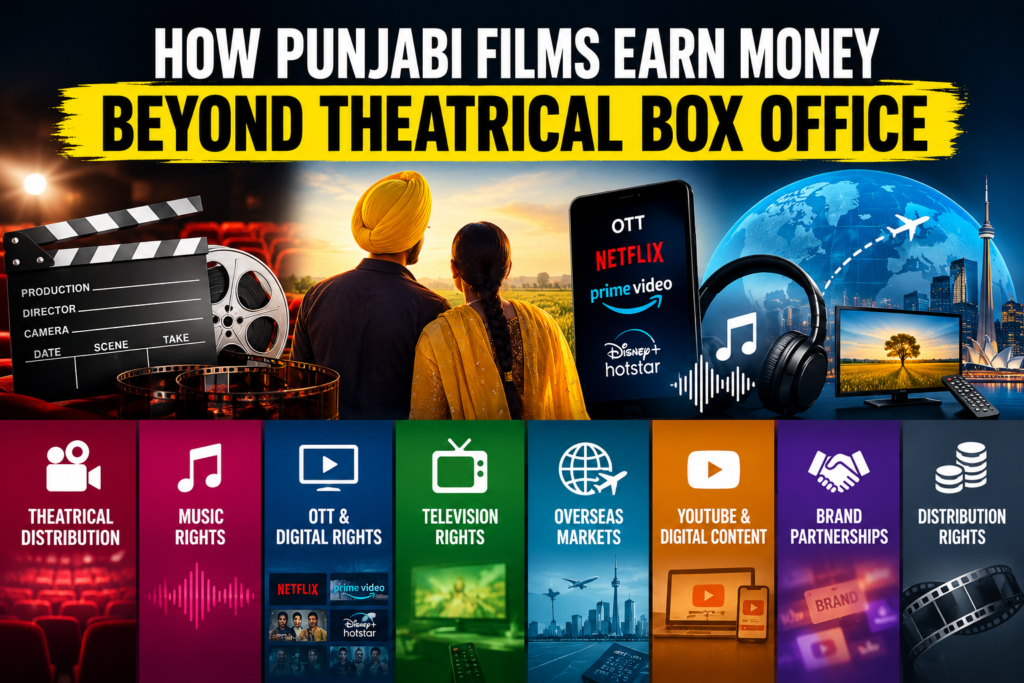
A breakdown of the major revenue streams that can contribute to a Punjabi film's business beyond theatrical ticket sales.
When a Punjabi film releases in cinemas, the box office usually becomes the biggest talking point.
Opening day numbers, weekend collections and worldwide gross figures dominate conversations among audiences and trade observers. But the theatrical collection is only one part of a film’s overall business.
A Punjabi film can have commercial value through several different channels, including music rights, OTT or digital licensing, television rights, overseas distribution and other commercial partnerships.
Understanding these revenue streams gives a more complete picture of how the Punjabi film business works.
The Box Office Is Not the Same as Producer Revenue
The first thing to understand is that a film’s reported box-office gross does not automatically become the producer’s income.
Ticket revenue is shared across the theatrical ecosystem. Depending on the agreement, exhibitors, distributors and producers can all have a financial interest in the theatrical business.
Therefore, a film that reports a particular gross collection cannot simply be described as having earned the same amount for its producer.
The exact recovery depends on the film’s distribution structure, territory, expenses and contractual arrangements.
This distinction is important when discussing whether a Punjabi film has recovered its investment.
1. Music Rights Can Create Value Before and After Release
Music is one of the most important parts of Punjabi entertainment culture, and film music can have commercial value beyond the movie itself.
A producer may license soundtrack or music rights to a music company or other digital partners.
The commercial value of these rights can depend on factors such as:
- Popularity of the singers
- Existing fan base of the artists
- Number of songs in the film
- Streaming potential
- YouTube performance
- Social-media engagement
- Music-label interest
- Long-term popularity of the soundtrack
A successful song can also work as a promotional asset for the film.
If a track becomes popular before release, it can increase awareness of the movie and potentially contribute to audience interest in theatres.
However, music revenue varies considerably from project to project and should not be treated as a fixed percentage of a film’s budget.
2. OTT Rights Give Films a Second Commercial Window
The theatrical release is no longer necessarily the final stage of a film’s commercial journey.
After its cinema run, a Punjabi movie may be licensed to an OTT or digital platform.
The value of an OTT deal can depend on:
- Cast and director
- Genre
- Existing audience demand
- Theatrical performance
- Overseas appeal
- Platform requirements
- Exclusivity
- Release timing
- Expected digital viewership
For regional cinema, digital platforms can also expand the geographical reach of a film.
A viewer who did not have access to the film during its theatrical release may discover it later through streaming.
This gives a movie a longer commercial and audience life.
Importantly, not every film receives the same OTT valuation. Digital deals are commercial agreements and their actual values are often not publicly disclosed.
3. Television and Satellite Rights
Television remains another potential revenue source for Punjabi films.
A broadcaster may acquire the rights to show a movie on television after its theatrical window or under a specific licensing arrangement.
The value of television rights can be influenced by:
- Popularity of the cast
- Genre
- Audience appeal
- Previous performance
- Family viewing potential
- Television demand
- Music popularity
Television can introduce a film to audiences who may not have watched it in theatres or on a particular streaming platform.
Although television economics differ from those of larger Hindi-film markets, the rights can still form part of a film’s overall recovery strategy.
4. Overseas Rights Are Especially Relevant to Punjabi Cinema
Punjabi cinema has an audience that extends well beyond Punjab.
Punjabi-speaking communities and Punjabi entertainment audiences across countries such as Canada, the United Kingdom, Australia and the United States create opportunities for international theatrical distribution.
A film may have separate distribution arrangements for different territories.
The performance of an overseas release can depend on:
- Size of the local Punjabi audience
- Number of screens
- Ticket pricing
- Cast popularity
- Previous performance of the film’s team
- Local competition
- Release timing
- Marketing
- Demand in individual cities
This is why overseas business should not be treated as one uniform market.
Canada, the UK, Australia and the US can have very different audience behaviour and commercial results.
5. Digital and YouTube Can Extend a Film’s Life
A movie can continue attracting audiences after its main theatrical and streaming windows.
Depending on ownership and licensing arrangements, digital content can generate value through:
- YouTube monetisation
- Music-video views
- Promotional clips
- Digital licensing
- Catalogue exploitation
- Short-form content
- Other online distribution arrangements
The long-term value of a film’s catalogue can become particularly relevant when its songs, scenes or promotional material continue to attract viewers years after release.
This means the commercial life of a Punjabi film does not necessarily end when its theatrical collection stops growing.
6. Brand Partnerships and Promotional Deals
Some films may also work with brands through promotional partnerships.
These arrangements can include:
- Product placement
- Co-branded campaigns
- Promotional integrations
- Sponsored events
- Digital campaigns
- Brand-supported film promotions
The scale of such deals varies significantly.
A film with a recognisable cast, popular music or a clearly defined audience may provide brands with an opportunity to reach a particular consumer group.
However, brand revenue should only be included in a film’s financial analysis when there is reliable information that such a commercial arrangement actually existed.
7. Distribution Rights Are a Major Part of the Business
Behind every theatrical release is a distribution structure.
Producers may work with distributors for particular territories or release arrangements. Depending on the deal, distributors may acquire rights, provide financial guarantees or participate in revenue sharing.
Commercial agreements can differ in terms of:
- Territory
- Duration
- Revenue sharing
- Minimum guarantees
- Distribution expenses
- Marketing responsibilities
- Exhibition arrangements
- Digital windows
Because many of these agreements are private, outsiders rarely have access to the complete financial picture.
That is why box-office figures alone cannot reveal exactly how much money every stakeholder earned.
A Film’s Revenue Can Come From Multiple Windows
A simplified way to understand the commercial journey is:
Production → Theatrical Release → Domestic & Overseas Distribution → Music → OTT/Digital → Television → Long-Term Catalogue
These stages do not necessarily happen in exactly the same order for every film.
Some rights may be licensed before release, while others may be negotiated after the theatrical performance becomes clearer.
The structure depends on the producer, distributors, platform demand and the specific commercial agreements involved.
Why a Strong Box Office Still Matters
Looking beyond the box office does not mean the theatrical business has become unimportant.
A strong cinema performance can create several benefits.
It can:
- Increase audience awareness
- Strengthen a film’s market reputation
- Generate stronger demand for digital rights
- Improve overseas visibility
- Increase music consumption
- Extend the film’s cultural relevance
In other words, theatrical performance can influence the value of the other parts of the film’s business.
The relationship works in both directions: music and digital promotion can help create theatrical awareness, while theatrical performance can influence later commercial opportunities.
Why Box Office Collection Cannot Tell the Complete Profit Story
Consider two fictional Punjabi films that both report the same worldwide gross.
Their financial outcomes could still be different.
One film might have:
- A higher production budget
- Higher marketing expenses
- Expensive distribution arrangements
- Lower-value digital rights
Another might have:
- A lower production cost
- Strong music-rights value
- Better overseas distribution terms
- A favourable OTT agreement
Therefore, the same box-office gross does not automatically mean the same level of profitability.
The key variables are cost, revenue share, rights income, distribution structure and overall recovery.
The Global Nature of Punjabi Cinema
Punjabi cinema has an important advantage in the form of a geographically distributed audience.
The industry has a strong domestic base, but Punjabi entertainment also travels across India and international diaspora markets.
Music, social media and streaming platforms have made this audience even more connected.
For filmmakers, that means a movie can potentially be treated as a broader entertainment property rather than only a theatrical product.
The commercial opportunity may extend from cinemas to music platforms, OTT services, television and international markets.
The Future of Punjabi Film Economics
As the entertainment industry continues to change, Punjabi filmmakers are likely to operate across an increasingly connected revenue ecosystem.
Theatrical releases remain important for visibility and immediate audience engagement. At the same time, digital platforms, music, overseas distribution and catalogue value can extend the commercial life of a project.
For producers and investors, the central question is therefore not simply:
“How much did the film collect at the box office?”
A more complete question is:
“How much commercial value did the film generate across all of its rights and markets?”
That distinction is essential for understanding modern Punjabi cinema economics.
Final Takeaway
A Punjabi film’s financial journey does not necessarily end at the cinema counter.
Theatrical distribution is one major component, but the overall business can also involve music rights, OTT and digital licensing, television rights, overseas distribution, YouTube and other commercial partnerships.
The exact contribution of each source varies from film to film, and many private agreements are not publicly disclosed.
For that reason, box-office collections should be treated as one part of the financial story rather than a complete measure of a film’s earnings or profitability.





1 thought on “How Punjabi Films Earn Money Beyond Theatrical Box Office”