

What Is a Punjabi Film’s Break-Even Point?
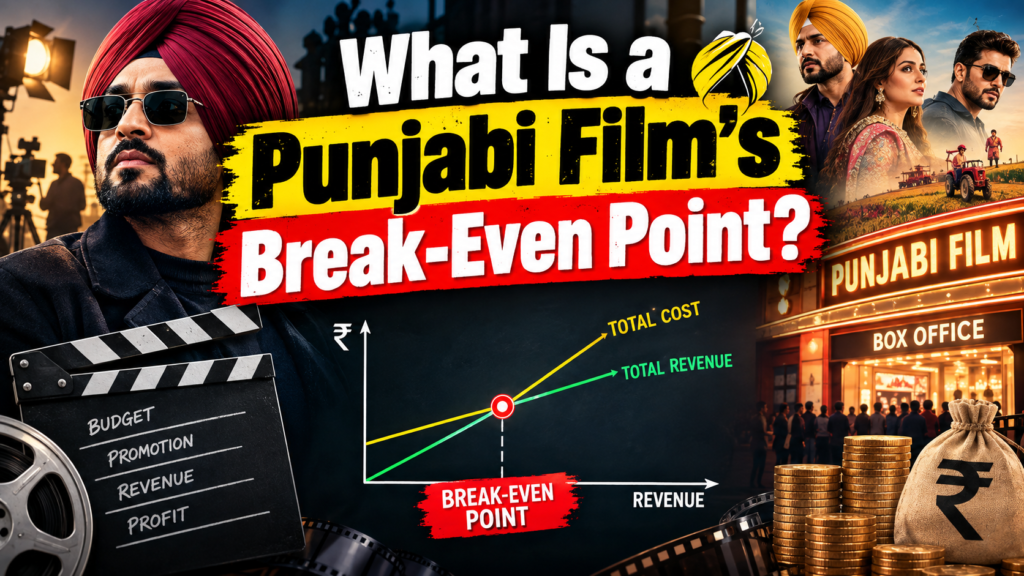
An editorial graphic explaining how a Punjabi film reaches its break-even point through theatrical and non-theatrical revenue.
A Punjabi film’s break-even point is the stage at which the total money generated by the film becomes enough to recover the costs involved in making, marketing and releasing it. In simple terms, a movie reaches break-even when its overall revenue is broadly equal to its recoverable investment.
For audiences, box-office collection is often the easiest number to notice. For producers, distributors and exhibitors, however, the financial picture is more complicated. A film can collect a certain amount at the box office without that entire amount returning to the producer.
Understanding the break-even point helps explain why a Punjabi movie with a seemingly strong collection may still be described as recovering its investment, while another film with a lower theatrical collection can remain financially viable because of revenue from OTT, music, satellite or overseas rights.
What Does Break-Even Mean in the Film Business?
Break-even does not simply mean that a movie has earned an amount equal to its production budget.
A film can have several expenses beyond production, including:
- Production costs
- Actor and director fees
- Post-production expenses
- Marketing and promotion
- Distribution-related costs
- Print, advertising and publicity expenses
- Release and other operational costs
At the same time, a movie can generate money from several different sources.
These may include:
- Theatrical revenue
- OTT or streaming rights
- Satellite television rights
- Music rights
- Overseas distribution
- Digital and other licensing arrangements
Therefore, the break-even calculation depends on the film’s complete financial structure rather than one headline box-office figure.
Production Budget vs Break-Even Point
One of the most common misconceptions is that the production budget and break-even point are the same thing.
They are not necessarily identical.
Suppose a Punjabi film has a reported production cost of ₹10 crore. If additional marketing, publicity and release expenses take the overall investment to ₹12 crore, the film’s financial recovery requirement could be higher than the production budget alone.
There can also be pre-release income.
For example, if the producers have already licensed the film’s music or streaming rights for a certain amount, part of the investment may already have been recovered before the theatrical release.
This is why a film’s total cost, pre-release revenue and theatrical share all matter when estimating break-even.
Why Box-Office Collection Is Not the Same as Producer Revenue
When a movie earns ₹1 crore at the box office, that does not mean the producer receives ₹1 crore.
The theatrical business involves different participants, including exhibitors and distributors. The amount eventually reaching the producer depends on the film’s distribution arrangement and contractual terms.
This distinction is particularly important when reading daily box-office reports.
A headline such as “Film X collects ₹5 crore” describes a gross collection figure in the relevant reporting context. It should not automatically be interpreted as ₹5 crore of profit for the producer.
The producer’s actual recovery can be considerably different.
How Is a Punjabi Film’s Break-Even Point Calculated?
There is no single universal formula that applies to every Punjabi movie.
A simplified example can help explain the basic idea.
Imagine a film has:
- Total recoverable cost: ₹12 crore
- Pre-release rights revenue: ₹4 crore
- Remaining amount to recover: ₹8 crore
If the producer’s effective theatrical share from the remaining business is, for illustration, around 50%, the film would need substantially more than ₹8 crore in theatrical gross collections to recover that amount from cinemas.
The actual percentage can vary depending on the distribution deal, territory, distributor terms, exhibitor arrangements and other commercial factors.
That is why simply adding up reported box-office gross numbers does not provide a complete break-even calculation.
The Role of Distribution Deals
Distribution is one of the most important factors in determining how a Punjabi film reaches its break-even point.
A producer may sell theatrical rights to a distributor for particular territories. In such a situation, the distributor’s financial exposure and the producer’s recovery position can be different.
For example, a distributor may acquire rights for Punjab, Delhi-NCR or overseas territories under a specific agreement. The distributor then attempts to recover the acquisition cost through theatrical business.
This creates multiple financial layers:
Producer → Distributor → Exhibitor → Audience
The money paid by audiences ultimately moves through this chain according to contractual arrangements.
As a result, two films with similar box-office collections can have very different financial outcomes depending on their deals.
How OTT Rights Can Change the Break-Even Equation
OTT has become an important part of the economics of Punjabi cinema.
A film may sell its streaming rights before or after theatrical release. If the OTT deal contributes significantly to the project’s recovery, the amount that needs to be recovered through cinemas can become lower.
For instance, consider a hypothetical ₹15 crore project.
If the producers receive ₹5 crore through a combination of non-theatrical rights, the remaining investment requiring recovery may be lower than ₹15 crore.
This does not mean the film automatically becomes profitable. The complete contractual structure still matters.
The key point is that theatrical performance is only one part of the financial picture.
Music and Overseas Rights Also Matter
Punjabi cinema has an additional advantage in the form of a strong music ecosystem and an international audience.
Music rights can provide revenue before or around the film’s release. Overseas markets, particularly territories with established Punjabi-speaking and diaspora audiences, can also contribute to the overall business.
However, overseas gross should not automatically be treated as direct producer profit. Distribution costs, local arrangements and revenue-sharing structures can affect the final amount recovered.
The same principle applies to music licensing.
A reported rights value is not necessarily the same as net profit.
Why There Is No Fixed Break-Even Number for Punjabi Films
Every movie has a different financial structure.
The break-even point can change because of:
- Production budget
- Marketing expenditure
- Distribution costs
- Pre-release rights
- Theatrical distribution terms
- Overseas rights
- Music rights
- OTT deal
- Satellite rights
- Revenue-sharing agreements
This is why statements such as “the film needs ₹20 crore to break even” should be treated carefully unless the underlying financial assumptions are known.
Industry reports often use estimated figures, while exact contracts are generally not publicly available.
Break-Even Is Different From Profit
Reaching break-even means recovering the relevant investment. It does not necessarily mean that the film has generated a large profit.
The broad progression can be understood as:
Loss → Recovery Phase → Break-Even → Profit
A movie below break-even may still have additional revenue opportunities after its theatrical run.
Similarly, a movie that reaches break-even can continue generating income from OTT, television, music or other licensing opportunities, depending on the rights structure.
Therefore, break-even should be considered a financial milestone rather than the final measure of a film’s lifetime business.
Can a Film Flop in Theatres and Still Recover Its Investment?
Yes, depending on its rights deals and overall cost structure.
A film with a weak theatrical performance may have already secured substantial OTT, satellite, music or overseas revenue.
Conversely, a movie with a strong theatrical gross may have a high financial burden because of a large budget, expensive marketing campaign or costly distribution acquisition.
This is one reason why box-office verdicts and financial profitability should not always be treated as identical concepts.
Why Break-Even Figures Are Often Estimated
Film producers and distributors do not always publicly disclose every component of a movie’s financial structure.
Reported budgets can differ between sources. Marketing costs may not be disclosed. Distribution contracts can be private, and rights deals may include different commercial conditions.
Therefore, publicly reported break-even figures should often be described as estimates unless supported by transparent financial information.
For reliable box-office analysis, it is important to distinguish between:
- Reported collection
- Estimated producer share
- Distribution revenue
- Rights revenue
- Total investment
- Estimated break-even
- Actual profit
These are separate financial concepts.
What Break-Even Tells Us About Punjabi Cinema
The break-even point provides a useful way to understand the economics behind Punjabi films.
It shows why a movie’s opening day is important but not necessarily decisive. A strong first weekend can improve theatrical recovery, while sustained collections over several weeks can help distributors and exhibitors.
At the same time, a film’s commercial structure increasingly extends beyond cinemas.
The combination of theatrical business, OTT, music, television and overseas markets means that Punjabi films can have multiple revenue pathways.
This also explains why the same box-office number can mean different things for different projects.
Pollywood Box Office News Network