

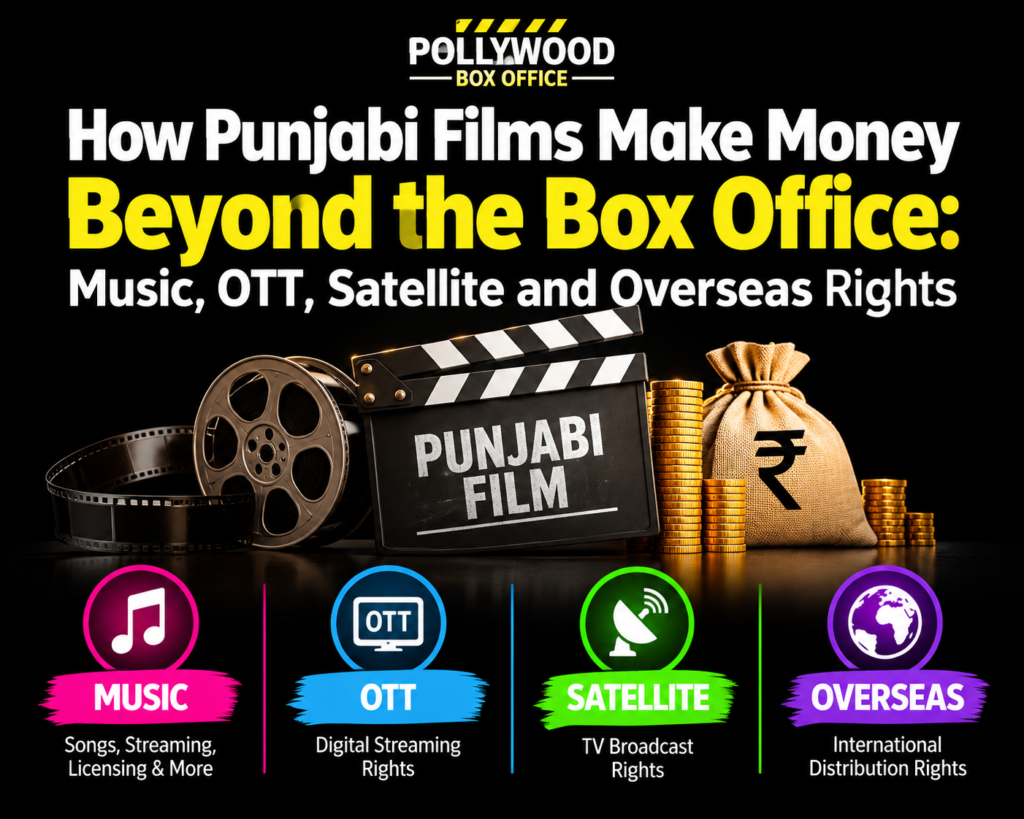
Punjabi films can generate revenue beyond ticket sales through music, OTT, satellite and overseas rights.
When people talk about the business of a Punjabi film, the first number they usually look at is the box office collection.
Did the movie open strongly? How much did it collect over the weekend? Did it become a hit? How much did it earn worldwide?
These numbers are important, but they do not tell the complete story.
A Punjabi film can generate revenue from several different sources before, during and after its theatrical run. Depending on the project, these can include theatrical exhibition, music rights, digital or OTT rights, television or satellite rights, overseas distribution and other commercial arrangements.
That is why understanding a film’s business requires looking beyond the box office.
Theatrical Box Office Is Only One Part of the Business
Theatrical revenue is often the most visible part of a movie’s commercial journey.
When audiences buy tickets, the money collected at cinemas does not simply go directly to the film producer. The theatrical business involves multiple parties, including exhibitors and distributors, with revenue being divided according to the terms of the relevant agreements.
This means a film’s total box-office collection and the amount ultimately received by its producers are not necessarily the same figure.
For Punjabi cinema, theatrical performance remains particularly important because a strong cinema run can improve the commercial value and visibility of the film across other platforms.
A successful theatrical release can also create stronger demand for its digital, television and overseas distribution opportunities.
1. Music Rights Can Become an Important Revenue Stream
Music is closely connected with Punjabi cinema.
A Punjabi movie can generate commercial value through its songs, soundtrack and music catalogue. Depending on the agreement, music rights may be licensed or sold to a music company or platform.
The value of a soundtrack can depend on several factors:
- Popularity of the singers
- Existing audience of the artists
- Number and quality of songs
- Streaming potential
- YouTube performance
- Social media popularity
- Long-term replay value
- Brand strength of the film and music label
For some Punjabi projects, music is not simply promotional material for the film. It can become an independent commercial asset.
A successful song may continue attracting audiences even after the movie has left cinemas.
2. OTT Rights Extend a Film’s Commercial Life
The theatrical release is no longer necessarily the end of a film’s commercial journey.
After its cinema run, a Punjabi film may become available through an OTT or digital platform under a licensing agreement.
The value of digital rights can depend on factors such as:
- Cast
- Genre
- Existing audience
- Theatrical performance
- Release timing
- Platform demand
- Geographic reach
- Exclusivity
- Previous digital performance of similar films
OTT also gives a film access to viewers who may not have watched it in cinemas.
This is particularly relevant to Punjabi cinema because the audience is geographically distributed across India and international markets.
A film that has completed its theatrical run can therefore continue generating audience attention through digital distribution.
3. Satellite and Television Rights
Television remains another potential part of a film’s post-theatrical business.
Depending on the project and market, television rights may be acquired by broadcasters or television networks.
The value of television rights can be influenced by the film’s cast, popularity, language, audience size and commercial performance.
For Punjabi cinema, television can also help a film reach households that may not regularly visit cinemas or use specific OTT platforms.
The important point is that a film’s commercial life does not necessarily end when theatrical ticket sales slow down.
4. Overseas Rights Matter for Punjabi Cinema
One of the distinctive characteristics of Punjabi cinema is the importance of overseas audiences.
Punjabi-speaking communities and Punjabi entertainment audiences exist across markets including Canada, the United Kingdom, Australia, the United States and other international regions.
This creates opportunities for overseas theatrical distribution and other forms of international exploitation.
A Punjabi film’s overseas business can depend on:
- Strength of the cast
- Popularity of the director
- Previous performance of the franchise or actors
- Punjabi diaspora audience
- Number of overseas screens
- Release timing
- Local competition
- Marketing
- Demand in individual territories
The overseas market should therefore not be treated as a single number.
Different territories can perform very differently, and distributors may structure their agreements according to individual markets.
5. Distribution Rights Shape the Economics
Before discussing profits, it is important to understand distribution.
A producer may work with distributors who acquire or handle theatrical rights for particular territories.
The commercial structure can vary from film to film.
For example, agreements may differ in terms of:
- Territory
- Minimum guarantees
- Revenue sharing
- Distribution fees
- Marketing responsibilities
- Exhibition arrangements
- Digital windows
- Duration of rights
Because these deals are often private, publicly reported box-office numbers cannot always reveal the exact financial position of every stakeholder.
This is why statements about whether a particular film has made a profit should be treated carefully unless reliable financial information is available.
6. Brand Partnerships and Promotional Deals
Some films can also create commercial opportunities outside traditional distribution.
A production may work with brands for promotional campaigns, product placements, partnerships or other marketing activities.
The scale of these arrangements varies considerably.
A film with strong actors, popular music or a clearly defined audience may offer brands access to a specific demographic.
However, not every film has significant brand revenue, and these arrangements should not automatically be assumed when calculating a movie’s profitability.
Box Office Collection Does Not Equal Profit
This is one of the most important concepts for anyone trying to understand film economics.
Suppose a movie reports a large worldwide gross.
That number alone does not tell us:
- How much the producer invested
- How much distributors paid
- How much cinemas retained
- How much was spent on marketing
- How much came from different territories
- What was earned from music rights
- What was earned from OTT rights
- What was earned from television rights
- What other commercial agreements existed
A film’s profitability depends on its overall cost structure and total revenue across multiple rights and markets.
This is why two films with similar box-office collections can potentially have very different financial outcomes.
A Film Can Continue Earning After Its Cinema Run
One of the biggest changes in the modern entertainment business is the extended life of a film.
A movie can move through several stages:
Theatrical Release
↓
Domestic Distribution
↓
Overseas Exhibition
↓
Music and Streaming Ecosystem
↓
OTT / Digital Release
↓
Television
↓
Long-Term Catalogue Value
Each stage can contribute to the overall commercial value of the project, depending on the rights structure.
This also explains why a film’s box-office performance should be viewed as one part of a larger business story rather than the entire story.
Why This Matters for Punjabi Cinema
Understanding these revenue streams is particularly useful when studying the growth of the Punjabi film industry.
Punjabi cinema operates across more than one geographical market.
Punjab is an important core market, but Punjabi films can also reach audiences elsewhere in India and across the global Punjabi diaspora.
At the same time, the rise of streaming platforms has made regional-language films accessible to viewers who may previously have had limited access to them.
This creates opportunities for Punjabi filmmakers to build value across multiple platforms.
The industry’s future therefore cannot be measured only through theatrical collections.
Music, digital distribution, overseas audiences and long-term catalogue value are also important parts of the ecosystem.
The Bigger Picture: From Film Release to Entertainment Business
A successful film is not simply a product sold through cinema tickets.
It can become an entertainment property with multiple commercial windows.
Theatrical performance creates visibility.
Music can build audience engagement.
OTT can extend accessibility.
Television can expand reach.
Overseas distribution can connect the film with international audiences.
Together, these channels can contribute to the commercial journey of a Punjabi film.
However, the exact contribution of each revenue source differs from project to project. Publicly available figures rarely provide a complete financial picture, so industry estimates should not be confused with audited accounts.
Final Takeaway
When someone asks, “How does a Punjabi film make money?”, the answer is much bigger than its box-office collection.
A film’s business can involve theatrical revenue, distribution rights, music, OTT, television, overseas markets and other commercial opportunities.
Theatrical success may generate the most attention, but the complete economics of a movie can extend well beyond the cinema.