
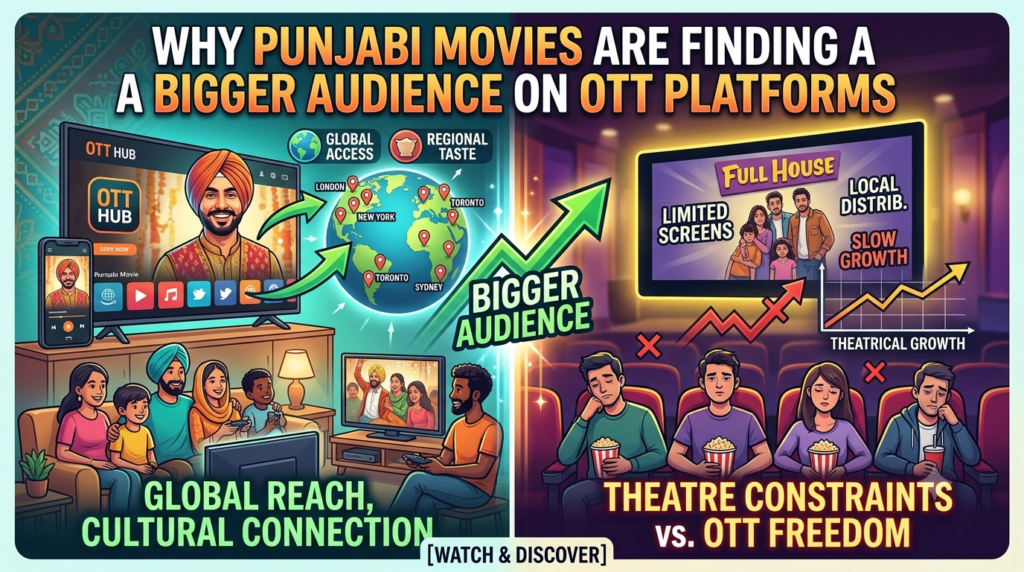
OTT platforms are helping Punjabi movies reach audiences across India and overseas beyond the traditional theatrical market.
Punjabi cinema has traditionally been closely associated with theatrical audiences in Punjab and Punjabi-speaking communities overseas. But the way audiences discover and watch Punjabi films is changing.
The growth of streaming has given Punjabi movies another route to reach viewers — one that is not limited by theatre locations, show timings or the number of screens available in a particular market.
Today, a Punjabi movie can find viewers in Punjab, other parts of India and overseas through digital platforms. For filmmakers and producers, this has created a larger potential audience and a new way to extend the life of a film after its theatrical run.
But why are Punjabi movies finding more space in the OTT ecosystem?
OTT Removes Geographical Barriers
Theatre distribution naturally limits where a movie can be watched.
A Punjabi film may have strong demand in Punjab and selected overseas markets, but it may have fewer theatrical shows in regions where Punjabi-speaking audiences are smaller.
Streaming changes that equation.
Once a movie becomes available digitally, viewers are no longer dependent on whether a nearby cinema is screening it. Someone living outside Punjab can discover and watch a Punjabi film from home.
This geographical flexibility is particularly important for regional cinema.
The Punjabi Diaspora Is a Natural Digital Audience
Punjabi cinema has a strong connection with audiences living outside India.
Punjabi-speaking communities in countries such as Canada, the United Kingdom, the United States and Australia have historically contributed to the international market for Punjabi entertainment.
OTT adds another layer to that relationship.
A viewer who misses a theatrical release may eventually discover the film through a streaming service. Someone who lives in a city without convenient access to Punjabi-language theatrical releases may also find digital viewing more practical.
For Punjabi cinema, this means the audience is not necessarily restricted to people who can visit a theatre during the first few weeks of release.
Convenience Is Changing Viewing Habits
One of OTT’s biggest advantages is convenience.
Theatre viewing requires audiences to choose a specific show, travel to a cinema and spend time outside the home. Streaming gives viewers more control over when and where they watch.
This can be especially useful for viewers who enjoy regional cinema but do not live in areas with frequent Punjabi theatrical releases.
The convenience factor also makes it easier for families and individual viewers to explore films they may not have considered watching in theatres.
OTT Gives Older Movies a Second Life
The value of streaming is not limited to new releases.
A Punjabi movie that had a short theatrical run can potentially find a new audience once it becomes available digitally.
This is important because theatrical performance and long-term audience reach are not always the same thing.
A film may have limited visibility during its cinema run because of competing releases, fewer screens or a short theatrical window. Digital availability can give viewers another opportunity to discover it.
Over time, this can help build a deeper catalogue of Punjabi cinema.
Discovery Is Becoming More Important
OTT has also changed how audiences discover movies.
In the traditional theatrical model, viewers often learn about a movie through trailers, posters, television promotion, music or word of mouth.
Streaming adds recommendation systems, platform categories, search and personalised discovery to the process.
A viewer who watches one Punjabi film may subsequently encounter other regional titles.
This can introduce audiences to films and actors they may not have actively searched for before.
For Punjabi cinema, this creates an opportunity to reach viewers beyond the established fan base.
Music and Movies Work Together
Punjabi cinema has an advantage that many other regional industries can use effectively: the strong connection between films and music.
Punjabi songs frequently travel beyond the film itself through YouTube, short-form videos, music platforms and social media.
When a song or artist generates attention, audiences may become curious about the movie connected to that music.
OTT can then provide another destination for that audience.
This creates a broader entertainment ecosystem where music can generate awareness, social media can create conversation and streaming can provide access to the complete film.
OTT Can Help New Actors Reach More Viewers
Established stars naturally bring recognition to a movie, but streaming can also help audiences discover emerging performers.
A new actor may not have the same theatrical pull as a major star. However, once a film becomes available digitally, viewers may watch it based on the story, genre, reviews, recommendations or curiosity.
If the performance connects with audiences, the actor can gradually build recognition.
This is particularly valuable for an industry that wants to develop the next generation of Punjabi stars.
Regional Language Content Has a Wider Digital Opportunity
India’s entertainment audience is multilingual.
People may regularly consume Hindi content while also watching films and series in Punjabi, Tamil, Telugu, Malayalam, Bengali, Marathi or other languages.
OTT platforms have made this behaviour easier because viewers can move between languages without changing their physical location.
Punjabi cinema therefore does not have to compete only within a Punjabi-speaking theatrical market.
Its potential digital audience includes viewers who may simply be interested in Indian regional stories.
OTT Does Not Replace Theatres
The rise of streaming should not be interpreted as the end of theatrical cinema.
Theatre releases still offer something digital platforms cannot completely reproduce — the shared big-screen experience.
For commercial Punjabi films, theatrical performance remains an important part of the business model and a major measure of audience demand.
Instead, OTT can be viewed as an additional stage in a movie’s life.
A film can first create an event in theatres and later reach viewers who did not watch it on the big screen.
The Business Model Is Also Changing
For producers, digital distribution can add another potential revenue opportunity.
A movie’s overall economics can involve theatrical revenue, music rights, satellite or television rights, digital rights and other commercial arrangements.
The importance of each component can vary depending on the film, its cast, audience demand, distribution strategy and market conditions.
This means a Punjabi film’s success cannot always be judged only by its theatrical box office.
A film can have a modest theatrical run but continue generating audience interest through other distribution channels.
At the same time, strong theatrical performance can increase the visibility and commercial value of a movie across the wider entertainment ecosystem.
Social Media Can Drive OTT Discovery
The journey does not end when a movie arrives on streaming.
Social media can bring older films back into public conversation.
A scene can become popular in a Reel. A dialogue can become a meme. An actor’s performance can be discussed by creators. A song can start trending again.
These moments can send viewers back to the movie.
For Punjabi cinema, this connection between social media, music and streaming is particularly important because entertainment discovery increasingly happens across multiple platforms rather than through one traditional promotional channel.
What Makes a Punjabi Movie Work on OTT?
The same factors that attract audiences in theatres can remain important on streaming, but the viewing environment is different.
Storytelling, performances, humour, emotional connection, music and cultural relevance can all influence whether viewers continue watching or recommend a film.
Discoverability is also important.
A strong title, attractive artwork, useful metadata and effective platform placement can help a movie stand out among a large catalogue of content.
The challenge for Punjabi filmmakers is therefore not simply getting a film onto a streaming service. It is making sure audiences have a reason to discover and watch it.
The Bigger Opportunity for Punjabi Cinema
OTT has expanded the definition of a Punjabi movie audience.
A film no longer needs to depend entirely on theatrical availability in Punjab or a handful of overseas markets.
Streaming can help connect Punjabi stories with audiences across India and around the world.
This is especially valuable for films that have strong cultural themes, distinctive characters, music-driven appeal or stories that can travel beyond their original market.
As digital viewing continues to become part of everyday entertainment, Punjabi cinema has an opportunity to build a stronger long-term catalogue and reach audiences who may never have encountered these films through traditional theatrical distribution.
Final Word
Punjabi movies are finding a bigger audience on OTT because streaming removes geographical barriers, improves convenience and gives films a longer opportunity to be discovered.
Theatrical cinema remains important, but the journey of a Punjabi film increasingly extends beyond the cinema hall.
For producers, actors and filmmakers, this creates a larger ecosystem in which theatre can create the event, music can create awareness, social media can create conversation and OTT can extend the film’s reach.
The biggest opportunity for Punjabi cinema may therefore not be choosing between theatres and streaming.
It may be learning how to use both to build a much larger audience for Punjabi stories.
Disclaimer: OTT availability, licensing arrangements, digital rights and release windows can vary by film and territory. This article discusses broader industry trends and does not imply a specific commercial arrangement for any individual movie.