
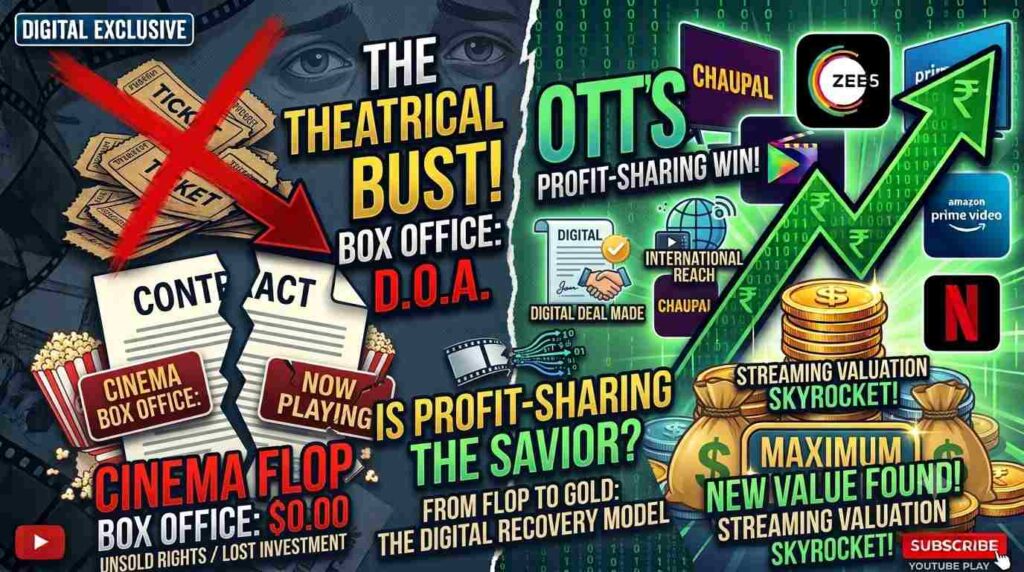
How OTT streaming can give an underperforming Punjabi film a second commercial window.
A Punjabi film’s theatrical performance is often treated as the final verdict on its commercial success. If a movie fails to recover expectations at the box office, it can quickly be labelled a flop.
But the rise of streaming has changed the life cycle of a film.
A movie that underperforms in cinemas can still find a second audience on OTT. It can generate additional digital revenue, reach viewers who did not visit theatres and remain available to audiences for years.
This raises an important question for Punjabi cinema:
Can OTT actually make a flop Punjabi film valuable again?
The short answer is that OTT can increase the commercial value and long-term reach of an underperforming film, but it cannot automatically turn a theatrical flop into a financial success.
The difference between the two is important.
Theatrical Failure Does Not Mean the Film Has No Value
A film’s theatrical performance is only one part of its overall revenue model.
For a Punjabi movie, the broader commercial ecosystem can include:
- Theatrical distribution
- Overseas theatrical rights
- OTT or digital rights
- Satellite television rights
- Music rights
- International digital audiences
- Ancillary licensing opportunities
Therefore, a film can have a weak theatrical run while still retaining value in other markets.
This is especially relevant for Punjabi cinema because the audience is geographically spread across India and a large overseas diaspora.
A film that fails to attract enough people to theatres during its initial run may find viewers later when it becomes available on a streaming platform.
Why OTT Gives Films a Second Life
The biggest advantage of streaming is accessibility.
A theatrical release gives a film a limited period in which audiences can watch it on the big screen.
OTT changes that model.
Once a movie is available digitally, viewers can watch it:
- At home
- On mobile devices
- On smart TVs
- At different times
- With family members
- From different countries and regions
This removes several barriers associated with theatrical viewing.
A viewer may not have watched a film because there was no convenient show nearby, the ticket price was too high, the release timing was inconvenient or the film received limited screen availability.
On OTT, many of those barriers disappear.
That can create a second opportunity for the film.
The OTT Audience Is Not Exactly the Theatre Audience
One of the most important reasons an underperforming film can find new viewers online is that OTT and theatrical audiences behave differently.
Going to a cinema requires a deliberate decision.
The viewer needs to choose a show, travel to the theatre, purchase a ticket and dedicate several hours to the experience.
Streaming is more flexible.
A viewer can discover a film months after its theatrical release and decide to watch it simply because it appears on the platform.
This creates a longer discovery window.
A movie that had limited theatrical awareness can therefore receive renewed attention after reaching OTT.
A Flop Film Can Still Have Digital Demand
Calling a film a theatrical flop does not necessarily mean that nobody wants to watch it.
There can be several reasons for a weak theatrical performance.
The film may have released during a crowded weekend.
It may have received limited screens.
Its marketing campaign may not have reached the right audience.
The target audience may have preferred another release.
The film may have been affected by poor timing.
Or audiences may simply have preferred to wait for OTT.
These factors can produce a disconnect between theatrical performance and eventual digital consumption.
However, this does not mean every flop film will automatically become popular online.
The content still matters.
Content Quality Becomes Important on OTT
OTT gives a film another opportunity, but it cannot completely replace audience interest.
A movie with strong storytelling, good performances or a niche subject may have better long-term streaming potential than its theatrical numbers suggest.
For example, a film may appeal to a specific segment of Punjabi audiences but fail to attract a sufficiently large theatrical crowd.
Streaming can help such a film reach that niche audience.
The important difference is scale.
A theatrical release generally needs concentrated demand within a short period.
OTT can benefit from distributed demand over a longer period.
That makes niche content more viable in the digital environment.
Punjabi Cinema Has a Natural Advantage
Punjabi cinema has an interesting advantage when it comes to streaming.
Its audience is not restricted to Punjab.
Punjabi-speaking and Punjabi-origin audiences are spread across different parts of India and major international markets.
This means a Punjabi film can potentially find viewers outside its original theatrical market.
Someone living overseas may not have had access to the film during its cinema release.
The same viewer can discover it on OTT months later.
Streaming therefore expands the geographical life of a Punjabi film.
Overseas Viewers Can Become Important After Theatrical Release
Overseas audiences are already an important part of Punjabi cinema’s commercial ecosystem.
But theatrical distribution overseas has practical limitations.
Not every Punjabi film receives the same number of screens in every country.
Show timings, distributor decisions, local competition and ticket demand can all affect performance.
OTT can remove some of these limitations.
A film becomes accessible to a much broader international audience through a single digital platform.
This does not guarantee large viewership, but it creates another opportunity to monetise the content.
OTT Rights Can Reduce the Damage
From a producer’s perspective, one of the biggest advantages of securing a digital deal is that the film can generate revenue beyond theatres.
If a film performs below expectations theatrically but has already secured a meaningful OTT rights deal, the overall financial picture may be less damaging than the box office alone suggests.
However, the size and timing of the OTT deal matter.
A high-value pre-release digital deal can provide significant protection.
A weak theatrical performer that sells its digital rights for a much lower amount after release may receive less financial support from OTT.
This is why OTT rights should not be treated as an automatic insurance policy against box-office failure.
The Difference Between Revenue and Profit
This is one of the most important points in understanding film economics.
Suppose a movie earns additional money from OTT after a weak theatrical run.
That does not automatically mean the producer has made a profit.
The final economics depend on:
- Production cost
- Marketing expenditure
- Financing costs
- Distribution arrangements
- Theatrical share
- Overseas revenue
- Digital rights
- Satellite rights
- Music revenue
- Other licensing income
A film with a very high production budget may still remain financially weak despite earning meaningful OTT revenue.
Therefore, OTT can improve the recovery position without necessarily changing the overall profit-loss outcome.
Can OTT Change the Public Perception of a Film?
Yes, potentially.
Theatrical reception is often shaped by the first few days.
OTT gives a film a much longer period to be discovered.
A movie that received limited attention during its theatrical release can become a talking point after streaming.
Social media clips, recommendations and word of mouth can bring older films back into public conversation.
This can sometimes change how audiences perceive a movie.
But a streaming resurgence is difficult to predict.
Not every theatrical flop becomes an OTT success.
Why Some Films Perform Better on OTT
The viewing environment can change how audiences experience a film.
A family-oriented movie may be easier to watch at home.
A slower drama may find viewers who were unwilling to spend money on a theatre ticket.
A niche subject may attract viewers specifically interested in that genre.
A film featuring familiar actors may also receive renewed attention when audiences discover it through recommendations.
OTT’s recommendation systems can further expose content to viewers who may not have encountered it during the theatrical campaign.
This creates a different commercial opportunity.
The Role of the OTT Platform Matters
Not all digital releases have the same potential.
A film’s performance can depend partly on:
- Platform size
- Punjabi content catalogue
- International availability
- Promotion on the platform
- Recommendation placement
- Release timing
- Competition from other titles
A film released on a platform with a strong Punjabi-speaking audience may have a different digital trajectory from one placed where its target audience is smaller.
Therefore, the OTT platform itself becomes part of the post-theatrical strategy.
Does a Bigger OTT Audience Mean More Revenue?
Not necessarily.
This is another area where assumptions can become misleading.
A film can receive strong streaming numbers without those numbers directly translating into the same kind of revenue that theatrical ticket sales generate.
The commercial structure of OTT deals is different.
Depending on the agreement, producers may receive a fixed rights payment or operate under another commercial arrangement.
Therefore, high viewership does not automatically mean the producer receives additional revenue in direct proportion to the number of viewers.
The value of OTT can come from the rights transaction, exposure and long-term audience reach.
OTT Can Also Protect a Film’s Long-Term Library Value
A film is not necessarily a short-term product.
Once available digitally, it can remain discoverable for an extended period depending on licensing arrangements.
This creates what can be called library value.
A film may continue attracting viewers after its initial OTT release.
For Punjabi cinema, this can be particularly useful because audiences frequently discover older movies through streaming platforms, social media recommendations and curated content collections.
A movie that initially struggled theatrically can therefore continue to have relevance.
But OTT Cannot Fix Every Problem
There is a limit to what streaming can achieve.
If a film has extremely weak audience reception, OTT availability may not create enough demand.
Similarly, if the film’s financial structure is heavily dependent on theatrical recovery, a modest digital deal may not be enough to compensate.
OTT can provide:
Additional revenue + additional reach + longer content life
But it does not guarantee:
Profit + hit status + complete recovery
These are separate outcomes.
The New Film Business Model
The traditional model was relatively straightforward:
Theatrical Release → Box Office → Television → Long-Term Library
The modern model is more interconnected:
Theatrical → OTT → Television → International Digital Audience → Long-Term Streaming
Each stage can contribute to the overall value of the film.
This makes it increasingly difficult to judge a movie’s complete commercial life using theatrical collections alone.
For trade analysis, the important question is therefore not only:
“Did the film succeed at the box office?”
It is also:
“How much value can the film create across its entire distribution life?”
What This Means for Punjabi Producers
For Punjabi producers, OTT provides an important additional monetisation route.
But it also changes expectations.
Producers cannot assume that a weak theatrical performance will be rescued automatically by streaming.
Instead, digital rights need to be considered as part of the film’s overall business plan from the beginning.
The strength of the film’s content, cast, target audience, production budget and distribution strategy can all influence its eventual OTT value.
A financially disciplined production may have a better chance of recovering from a weak theatrical run than an expensive project that requires a very high box-office number to break even.
The Real Answer: OTT Can Add Value, Not Rewrite History
Can OTT make a flop Punjabi film valuable again?
Yes, but with an important qualification.
OTT can give an underperforming film a second commercial window.
It can generate digital-rights revenue, expand the audience, reach overseas viewers and increase the film’s long-term library value.
But it cannot erase the fact that the film underperformed theatrically.
A movie remains a theatrical flop if it fails to meet its theatrical business expectations.
What OTT can do is reduce the damage, improve overall monetisation and potentially extend the film’s commercial life.
That distinction is becoming increasingly important in Punjabi cinema.
Conclusion
The rise of OTT has made the box-office verdict less final than it once was.
A weak theatrical run no longer necessarily means that a Punjabi film disappears from the market immediately.
Streaming can provide another opportunity to reach audiences and monetise the content.
But the size of that opportunity depends on the film, its rights deal, its platform, audience interest and overall cost structure.
The most accurate way to look at OTT is therefore not as a rescue mechanism, but as a second commercial window.
For Punjabi cinema, that second window could become increasingly important as audiences continue to divide their entertainment time between theatres and digital platforms.
A theatrical flop may not become a hit because of OTT.
But it can still become a more valuable piece of content than its box-office performance initially suggested.
Disclaimer
This article discusses general film-business and OTT economics. Actual profitability and rights valuations vary from film to film depending on production cost, distribution agreements, theatrical revenue, digital rights, satellite rights, music rights, taxes, marketing expenditure and other commercial terms. Individual OTT deals and viewership figures should be considered only when officially confirmed or supported by credible trade sources.