
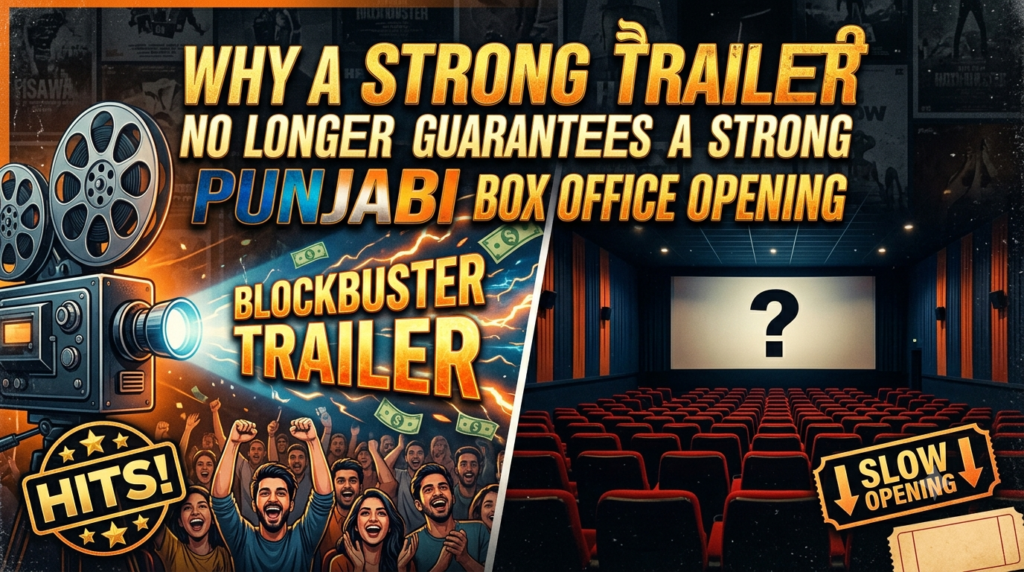
Why strong trailer views no longer guarantee a strong Punjabi box office opening in 2026.
A strong trailer has traditionally been one of the biggest marketing tools for a Punjabi film. A well-cut trailer can create excitement, generate social media discussion and give audiences an early impression of a movie’s scale, genre and cast.
But in 2026, a strong trailer is no longer a guarantee of a strong theatrical opening.
Punjabi cinema has become more competitive, while audiences have more entertainment choices than ever before. A trailer can attract millions of views and still fail to convert that attention into enough paid theatre visits.
The gap between digital interest and actual ticket buying is becoming increasingly important for understanding the Punjabi box office.
Trailer Views and Ticket Sales Are Two Different Things
One of the biggest mistakes in modern film marketing is treating trailer views as a direct indicator of box office potential.
A trailer view tells us that someone watched or interacted with the promotional video.
It does not necessarily mean that the person will buy a cinema ticket.
A viewer may watch a trailer because of:
- Curiosity
- A popular actor
- A trending song
- Social media promotion
- YouTube recommendations
- Friends sharing the video
- Interest in the trailer itself
But the decision to visit a theatre involves additional factors.
The audience may ask:
Is this film worth paying for in a theatre?
That question is much more important than whether someone watched the trailer.
The Punjabi Audience Has More Choices Now
The theatrical environment has changed significantly.
A Punjabi movie is no longer competing only with another Punjabi release.
It competes for the audience’s entertainment budget against Hindi films, South Indian cinema, Hollywood releases, streaming platforms, short-form video and other digital entertainment.
This has increased the importance of the film’s actual theatrical proposition.
If audiences believe a movie offers something worth experiencing on the big screen, the trailer can help convert interest into bookings.
If the trailer creates curiosity but does not establish a strong reason to watch the film theatrically, the conversion can be much weaker.
Star Power Can Create Attention, But Not Always Footfall
A popular actor can generate significant attention around a trailer.
Fans may share clips, comment on songs and discuss the film across social media.
However, star popularity alone does not guarantee that every fan will purchase a ticket.
The commercial strength of a star depends on several factors, including:
- Recent box office performance
- Audience perception
- Genre
- Character
- Film’s scale
- Release timing
- Competition
- Word of mouth
A major star can provide a valuable opening-day advantage, but the film still needs to convert that awareness into theatrical demand.
Genre Still Matters
The trailer may be impressive, but audiences ultimately need to understand what experience they are buying.
A comedy trailer has to communicate humour.
An action film needs to communicate scale and excitement.
A family drama needs to establish an emotional connection.
A thriller needs to create curiosity without giving away too much.
If the trailer looks technically strong but fails to clearly communicate the film’s core appeal, the marketing campaign can create views without creating sufficient ticket demand.
This is particularly important in Punjabi cinema, where audiences often respond strongly to familiar genres but also expect a film to offer something fresh.
The First Weekend Has Become More Important
The modern theatrical market is increasingly sensitive to opening-weekend performance.
A film that receives strong audience support on Friday and Saturday has a better chance of building momentum through word of mouth.
But a film that generates large promotional numbers before release and then opens below expectations can face a difficult situation.
The problem becomes even bigger when:
High trailer engagement → high expectations → weak opening → negative conversation
Once that cycle begins, social media discussion can quickly change from excitement to disappointment.
That is why producers and distributors cannot evaluate a campaign purely through pre-release numbers.
Advance Booking Can Tell a Different Story
One of the more useful indicators of theatrical demand is advance booking.
Trailer views measure attention.
Advance bookings can provide a stronger indication of intent to watch.
The difference is important.
Someone watching a trailer is saying:
“This looks interesting.”
Someone purchasing a ticket is saying:
“I am willing to pay to watch this.”
For trade observers, that distinction matters.
A strong trailer campaign should ideally translate into stronger searches, ticket enquiries, advance bookings and occupancy.
If those indicators remain weak despite strong digital engagement, the marketing campaign may not be converting effectively.
Social Media Buzz Is Not the Same as Mass Audience Demand
Social media can make a film appear much bigger than its actual theatrical demand.
A trailer may trend on YouTube or generate significant engagement on Instagram, but social media users represent only part of the potential cinema audience.
Punjabi cinema has a particularly interesting audience structure because its market extends beyond Punjab into other parts of India and major overseas Punjabi communities.
Therefore, a successful theatrical campaign has to create demand across multiple audience groups rather than simply dominate social media conversation.
Overseas Audience Can Change the Opening Equation
The international Punjabi audience is an important part of the industry’s theatrical economics.
Markets such as Canada, the UK, Australia and other overseas territories can contribute meaningfully to a film’s overall business.
However, overseas popularity also cannot be assumed from trailer performance alone.
A trailer may perform strongly among diaspora audiences online without producing the same level of theatre attendance.
Local release timing, competing films, ticket prices, show availability and audience interest can all influence actual collections.
This is why overseas digital engagement should be treated as an indicator of awareness, not a guaranteed box-office number.
Music Can Inflate Pre-Release Engagement
Punjabi films often benefit from music-driven promotion.
A popular song can significantly increase a film’s visibility before release.
But there is a difference between a hit song and a hit film.
A song may become popular independently of the movie.
People can stream the track without having any intention of watching the film in theatres.
This creates another potential disconnect between digital numbers and theatrical performance.
For producers, the real objective should therefore be to convert music popularity into interest in the complete film.
Release Date Can Matter More Than Trailer Views
Even a highly anticipated film can struggle if it arrives at the wrong time.
The release calendar affects:
- Number of available screens
- Show timings
- Competing releases
- Holiday advantage
- Audience spending
- Overseas competition
A strong trailer cannot completely eliminate these market factors.
A film releasing during a crowded weekend may receive fewer screens or less audience attention than expected.
On the other hand, a well-positioned release can allow a film with moderate pre-release buzz to build stronger theatrical momentum.
This is why box-office analysis should always consider the release environment alongside marketing performance.
Word of Mouth Still Has the Final Say
Perhaps the biggest factor separating trailer hype from box-office success is audience word of mouth.
The trailer controls the audience’s expectations.
The movie controls what happens next.
If audiences enjoy the film, positive conversations can increase weekend and weekday collections.
If audiences react negatively, the same expectations created by the trailer can work against the film.
This makes the first few shows extremely important.
A strong trailer can bring people to the theatre once.
A strong movie can convince them to recommend it to others.
That second stage is what can turn an opening into a sustained theatrical run.
What Should Producers Measure Instead of Trailer Views?
Trailer views remain useful, but they should be considered alongside several other indicators.
A more complete pre-release picture can include:
1. Trailer Engagement
Views, likes, comments and shares can indicate awareness.
2. Search Interest
Increasing searches around the film can indicate growing curiosity.
3. Advance Booking
This is a stronger indicator of actual purchase intent.
4. Show Demand
If additional shows are being added because of demand, that can provide a useful market signal.
5. Social Sentiment
The nature of the conversation can be more important than its volume.
6. Music Performance
Songs can create awareness, but their conversion into movie interest should also be evaluated.
7. Audience Feedback
Early reviews and audience reactions can determine whether the opening momentum continues.
Together, these indicators provide a more realistic picture than trailer views alone.
The New Box Office Formula
For Punjabi cinema in 2026, the relationship can be simplified as:
Trailer Awareness + Star Power + Release Timing + Advance Booking + Audience Interest + Word of Mouth = Box Office Potential
But even this is not a guaranteed formula.
Cinema remains an unpredictable business.
A film can have a strong cast and excellent marketing but fail to connect with audiences.
Another film with relatively modest pre-release expectations can outperform because viewers respond strongly to the content.
That unpredictability is one of the reasons box-office analysis needs to look beyond promotional numbers.
Why This Matters for Punjabi Cinema
The changing relationship between trailers and theatrical openings reflects a broader shift in audience behaviour.
Punjabi audiences are increasingly exposed to content before deciding where to spend their entertainment budget.
They can watch trailers, songs, interviews, reviews and short clips before a film reaches cinemas.
This means the marketing campaign has to do more than generate awareness.
It has to build confidence.
The audience needs to believe that the film deserves a theatre visit.
That is a much harder target than simply generating views.
Conclusion
A strong trailer remains extremely valuable for a Punjabi film, but it should be treated as the beginning of the box-office journey rather than its final predictor.
Trailer views can create awareness.
Star power can create curiosity.
Music can create visibility.
Marketing can create expectations.
But ultimately, audiences buy tickets for the film, not the trailer.
In 2026, the more meaningful question for Punjabi cinema is therefore not:
“How many people watched the trailer?”
It is:
“How many of those viewers decided to buy a ticket?”
That conversion—from digital attention to theatrical action—could become one of the most important indicators for understanding the next phase of Punjabi box-office performance.
Disclaimer
Box-office performance depends on several factors, including release timing, screen availability, ticket pricing, audience response, competition, marketing, reviews and word of mouth. Trailer views, social media engagement and other digital metrics should not be treated as direct guarantees of theatrical collections. Box-office figures and industry estimates can vary depending on the source and reporting method