Punjabi Cinema: Complete History, Evolution and Growth from 1935 to 2026
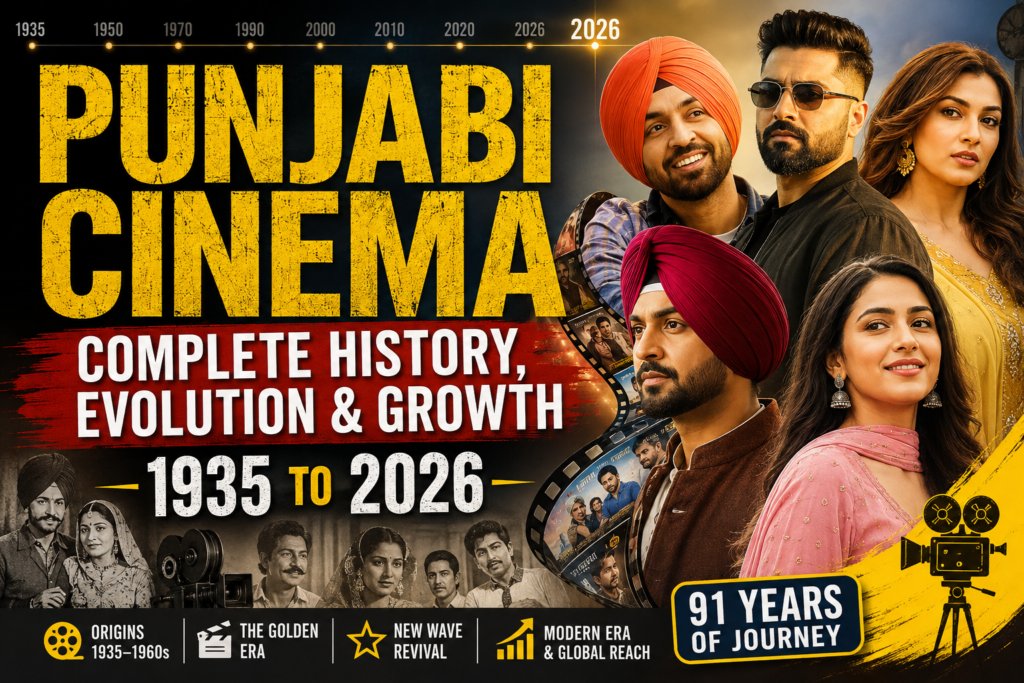
Punjabi cinema is more than a regional film industry. Its history is closely connected with Punjab’s literature, folk traditions, music, migration, Partition and changing social identity. From early filmmaking in Lahore to today’s theatrical, overseas and OTT markets, Punjabi cinema has experienced several distinct phases of growth.
Although 1935 is commonly used as the starting point for the history of Punjabi-language cinema, the story actually begins earlier. Silent filmmaking had already developed in Lahore, while Heer Ranjha became an important early sound milestone in 1932. The first Punjabi-language talking feature generally associated with this transition was Ishq-e-Punjab, also known as Mirza Sahiban, released in Lahore in 1935.
Over the following nine decades, Punjabi cinema moved through Partition, periods of decline, revival, the rise of television and music-driven stardom, multiplex expansion, overseas distribution and finally the streaming era.
What Is Punjabi Cinema?
Punjabi cinema refers primarily to films made in the Punjabi language and connected to Punjabi-speaking audiences and culture.
The industry is popularly known as Pollywood. Its creative and commercial ecosystem has historically extended beyond present-day Punjab in India. Lahore was an important filmmaking centre before the Partition of India in 1947, while Mumbai, Delhi, Chandigarh and Punjab later became important centres for Punjabi film production.
This geographical history is important because Punjabi cinema cannot be understood only through the modern Indian state of Punjab. The industry’s early development took place in the cultural landscape of undivided Punjab.
Punjabi Cinema Before 1935: The Beginning in Lahore
The roots of Punjabi cinema go back to the silent-film era.
Lahore emerged as an important centre of filmmaking during the 1920s. G.K. Mehta’s Daughters of Today, associated with production in Lahore, is generally cited as one of the earliest films connected with the region and reached the screen in the late 1920s.
Filmmakers such as A.R. Kardar also became important pioneers of the Lahore film scene.
The early films were influenced by:
- Punjabi folklore
- Historical stories
- Mythology
- Romance
- Theatre
- Folk music
- Popular literary traditions
This foundation would later become one of the defining characteristics of Punjabi cinema.
1932: Heer Ranjha and the Sound Era
One of the most important early milestones came in 1932 with Heer Ranjha.
Directed by A.R. Kardar, the film was based on the famous Punjabi love story associated with Waris Shah’s literary tradition. It is widely described as the first Punjabi sound film or first Punjabi talkie made in Punjab.
However, there is an important historical distinction.
The 1932 Heer Ranjha was a sound film, but sources differ when defining the first Punjabi-language talkie. Film historian Bhim Raj Garg’s research identifies Ishq-e-Punjab, also known as Mirza Sahiban, as the first Punjabi talking feature, released in Lahore in 1935.
This distinction makes 1932–1935 a crucial formative period rather than treating one year as the complete beginning of Punjabi cinema.
1935: The Punjabi-Language Film Era Takes Shape
The year 1935 is particularly significant because of Ishq-e-Punjab, also known as Mirza Sahiban.
The film was released at Niranjan Talkies in Lahore on March 29, 1935, according to research cited by film historian Bhim Raj Garg.
Around the same period, K.D. Mehra’s Sheela, popularly known as Pind Di Kudi, became another major landmark. The film was produced in Calcutta and released in Lahore, demonstrating that Punjabi filmmaking was already operating across geographical production centres.
The film also introduced Noor Jehan as a child performer, helping establish the powerful relationship between Punjabi cinema and music.
The 1930s: Punjabi Folklore Becomes Cinema
The 1930s established a storytelling formula that would remain important for decades.
Films drew heavily from famous Punjabi stories such as:
- Heer-Ranjha
- Mirza-Sahiban
- Sohni-Mahiwal
- Sassi-Punnu
- Dulla Bhatti
- Folk romances and legends
The popularity of these stories showed that Punjabi audiences responded strongly to films that reflected their own cultural memory.
The decade also saw films such as Heer Syal, Sassi Punnu, Sohni Mahiwal, Gul Bakavli and Yamla Jatt.
Music was already becoming a central commercial component of Punjabi cinema.
1940s: Punjabi Cinema Before and During Partition
The early 1940s brought further development to Lahore’s film industry.
Studios and production companies helped establish Lahore as an important filmmaking centre in undivided India. Punjabi cinema developed alongside the Hindi and Urdu film industries, with artists frequently moving between languages and production centres.
But the decade ended with one of the biggest disruptions in the history of the industry.
The Impact of Partition in 1947
The Partition of India fundamentally changed Punjabi cinema.
Punjab was divided between India and Pakistan, with Lahore becoming part of Pakistan. Filmmakers, actors, musicians, technicians and producers were displaced or moved to other film centres.
The disruption affected the entire creative ecosystem.
Many artists from Lahore moved toward Bombay and other Indian film centres, while the Pakistani side developed its own Punjabi and Urdu film industries.
Partition therefore created two interconnected but separately developing Punjabi cinematic traditions.
1950s: Rebuilding Punjabi Cinema
The post-Partition period was difficult for Punjabi cinema in India.
The industry had lost Lahore as its historic production centre, and filmmakers had to rebuild production networks in a new environment.
Nevertheless, Punjabi films continued to appear, while artists connected with Punjabi culture became major figures in Indian cinema.
During this period, Punjabi filmmaking gradually developed around new production centres and audiences in Indian Punjab and beyond.
The industry also faced competition from Hindi cinema, which had a much larger commercial market.
1960s: Punjabi Cinema Finds a Strong Cultural Identity
The 1960s became an important period for Punjabi cinema’s cultural identity.
Punjabi films increasingly combined:
- Family stories
- Rural life
- Religion
- Folk traditions
- Comedy
- Romance
- Music
- Social themes
One of the biggest milestones of the decade was Nanak Naam Jahaz Hai, released in 1969.
The film, directed by Ram Maheshwary, became an important cultural event and won the National Film Award for Best Feature Film in Punjabi as well as the National Film Award for Best Music Direction.
Its success demonstrated that Punjabi cinema could become commercially significant while also carrying strong cultural and religious themes.
1970s: Stars, Music and Popular Entertainment
The 1970s saw Punjabi cinema develop a more recognizable popular-film structure.
Comedy, romance, family drama and music became important elements.
Actors such as Mehar Mittal became closely associated with Punjabi film comedy, while performers such as Veerendra emerged as major stars in the following phase.
Punjabi cinema continued to compete with Hindi films for audiences, but its strongest advantage remained its connection with Punjabi language and culture.
1980s: Chann Pardesi and a New Era
The 1980s produced one of the most important milestones in Indian Punjabi cinema.
Chann Pardesi, released in 1980, became the first Punjabi film to win the National Film Award for Best Feature Film, according to historical accounts of Punjabi cinema.
The film featured actors including Raj Babbar, Rama Vij, Amrish Puri, Om Puri and Kulbhushan Kharbanda.
The decade also saw films such as Putt Jattan De and Yaari Jatt Di become commercially important. Yaari Jatt Di was notable for having more than half of its footage shot in the United Kingdom, an early sign of the growing relationship between Punjabi cinema and overseas Punjabi audiences.
This overseas connection would become much more important in the decades that followed.
1990s: A Difficult Phase
The 1990s were challenging for Punjabi cinema.
Hindi cinema became increasingly dominant, while television changed entertainment consumption across India.
Punjabi film production struggled with:
- Limited theatrical infrastructure
- Financing problems
- Competition from Hindi films
- Changing audience habits
- Limited marketing
- Piracy
- Weak distribution networks
However, Punjabi music remained extremely popular.
This became an important foundation for the industry’s later revival.
2000s: The Revival of Modern Pollywood
The 2000s marked a significant transformation.
A new generation of filmmakers and performers began treating Punjabi cinema as a more commercially structured industry.
The growth of Punjabi music videos and satellite television created a strong celebrity ecosystem.
Actors and singers increasingly crossed between music and cinema.
This period helped establish the modern model in which a Punjabi film could benefit from:
Music + Star Power + Overseas Audience + Theatrical Release + Television + Later Digital Distribution
The audience was no longer limited to Punjab.
Canada, the United Kingdom, the United States and Australia became increasingly important markets for Punjabi entertainment.
2010s: The Commercial Expansion of Pollywood
The 2010s were arguably the most transformative decade for modern Punjabi cinema.
Punjabi films began receiving greater visibility in multiplexes and overseas markets.
The industry produced successful comedies, family entertainers, romantic films, dramas and socially themed movies.
The emergence of stars such as:
- Diljit Dosanjh
- Gippy Grewal
- Ammy Virk
- Neeru Bajwa
- Sargun Mehta
- Binnu Dhillon
- Sonam Bajwa
- Gurpreet Ghuggi
helped create a recognizable modern Punjabi film-star system.
The industry also became more professional in areas such as:
- Marketing
- Trailer launches
- Music promotion
- Overseas distribution
- Digital promotion
- Production planning
- Multiplex distribution
Punjabi cinema was increasingly being treated as a commercial industry rather than simply a regional cultural product.
2020s: From Regional Industry to Global Punjabi Entertainment
The 2020s brought another major change.
Punjabi cinema entered an ecosystem where theatrical films, streaming platforms, social media and music could work together.
A film’s audience could discover it through:
Instagram → YouTube → Music → Trailer → Theatre → OTT → Social Media
This changed the way Punjabi films were marketed and consumed.
Streaming platforms also created additional opportunities for Punjabi-language movies and series.
The theatrical market remained important, but OTT became an additional distribution window rather than simply an alternative to cinemas.
Punjabi Cinema and the Overseas Market
The overseas audience has become one of the defining characteristics of modern Punjabi cinema.
Large Punjabi-speaking and Punjabi-origin communities live in countries including:
- Canada
- United Kingdom
- United States
- Australia
- New Zealand
For many Punjabi films, overseas markets are not simply an additional audience. They can influence the commercial strategy of a release.
A film’s overseas potential can affect:
- Distribution rights
- Show allocation
- Marketing
- Release timing
- Promotional tours
- Music launches
- International premieres
The industry’s international identity has therefore become an important part of its modern business model.
How Music Changed Punjabi Cinema
Music has always been central to Punjabi entertainment, but its role became even more powerful in the digital era.
A successful Punjabi song can introduce a film to audiences before its theatrical release.
This creates a promotional chain:
Song → Artist → Social Media → Trailer → Film → Theatre → OTT
Punjabi singers have also increasingly entered acting, while established actors have participated in music projects.
This crossover has helped create a larger entertainment ecosystem around Punjabi cinema.
Punjabi Cinema in the OTT Era
OTT platforms have changed the life cycle of Punjabi films.
Traditionally, a film’s journey was largely:
Theatre → Television → Home Video
The modern model can be:
Theatre → OTT → Digital Discovery → Long-Term Streaming
This has several consequences.
1. Longer Audience Life
A film can continue finding viewers after its theatrical run.
2. Global Accessibility
Punjabi films can reach viewers outside traditional Punjabi-speaking markets.
3. Greater Content Diversity
OTT platforms can accommodate genres and stories that may have smaller theatrical audiences.
4. New Business Opportunities
Producers have an additional potential distribution window.
The OTT era therefore does not necessarily replace theatrical cinema. Instead, it has expanded the overall distribution ecosystem.
The Rise of New Punjabi Storytelling
Modern Punjabi cinema is no longer restricted to village-based comedy or traditional romance.
Contemporary filmmakers have explored:
- Migration
- Mental health
- Family relationships
- Historical subjects
- Social inequality
- Identity
- Crime
- Women-centric stories
- Youth culture
- Diaspora experiences
- Intergenerational conflict
This expansion is important for the industry’s long-term development.
A mature film industry needs multiple genres rather than depending on a single formula.
Punjabi Cinema in 2026
By 2026, Punjabi cinema has evolved into a multi-platform entertainment ecosystem.
Its development can broadly be understood through several stages:
| Period | Major Development |
|---|---|
| 1920s | Silent filmmaking and Lahore’s early film culture |
| 1932 | Heer Ranjha and the early sound era |
| 1935 | Punjabi-language talking cinema gains a major milestone |
| 1930s–40s | Folklore, music and literary stories dominate |
| 1947 | Partition disrupts the Lahore-based ecosystem |
| 1950s | Post-Partition rebuilding |
| 1960s | Stronger cultural and religious themes |
| 1970s | Popular entertainment, comedy and music |
| 1980s | National recognition and early overseas connections |
| 1990s | Industry challenges and competition from Hindi cinema |
| 2000s | Modern Pollywood revival |
| 2010s | Commercial and overseas expansion |
| 2020s | OTT, social media and global audience growth |
| 2026 | Multi-platform Punjabi entertainment ecosystem |
Recent academic and institutional discussions of Punjabi cinema also describe the industry’s transformation from folk-rooted regional filmmaking toward a cinema with an increasingly global audience.
Why Punjabi Cinema Has Survived for More Than 90 Years
The industry’s survival is not based on one factor.
Five forces have repeatedly helped Punjabi cinema adapt:
1. Strong Cultural Identity
Punjabi cinema has a large reservoir of folk stories, literature, music and traditions.
2. Music
Songs provide Punjabi films with an additional discovery and marketing channel.
3. Diaspora
The international Punjabi audience provides an important market outside India.
4. Star System
Actors and singers can create audiences across multiple entertainment formats.
5. Adaptability
The industry has repeatedly changed its business model in response to technology and audience behaviour.
The Future of Punjabi Cinema
The next phase of Punjabi cinema will likely be shaped by a combination of theatrical and digital distribution.
The important questions for the industry are no longer simply about how many films are produced.
They include:
- Can Punjabi films expand into new international markets?
- Can filmmakers develop more genres?
- Can mid-budget films find sustainable audiences?
- How important will OTT rights become?
- Can Punjabi filmmakers build globally recognized franchises?
- Will overseas audiences continue to grow?
- Can stronger production infrastructure improve film quality?
- How can Punjabi cinema preserve cultural identity while reaching wider audiences?
These questions will define the industry’s next stage.
Punjabi Cinema: From Lahore to the World
The history of Punjabi cinema is ultimately a story of adaptation.
Today, Punjabi cinema operates across theatres, television, music platforms, social media and OTT services.
That makes the history of Pollywood much larger than a list of films and actors.
It is the story of how a language, culture and audience continued to build a cinematic identity across political borders, technological changes and generations.
From the early films of the 1930s to the global Punjabi entertainment ecosystem of 2026, the industry’s biggest achievement has been its ability to evolve without losing its cultural identity.
Editorial note: Historical dates and “first film” descriptions can vary depending on whether researchers define the first Punjabi film, first sound film made in Punjab, or first Punjabi-language talkie differently. This article follows the distinctions found in historical research rather than presenting a disputed milestone as an absolut
Buy Branded Buy Neonwale NEON LIGHTS