

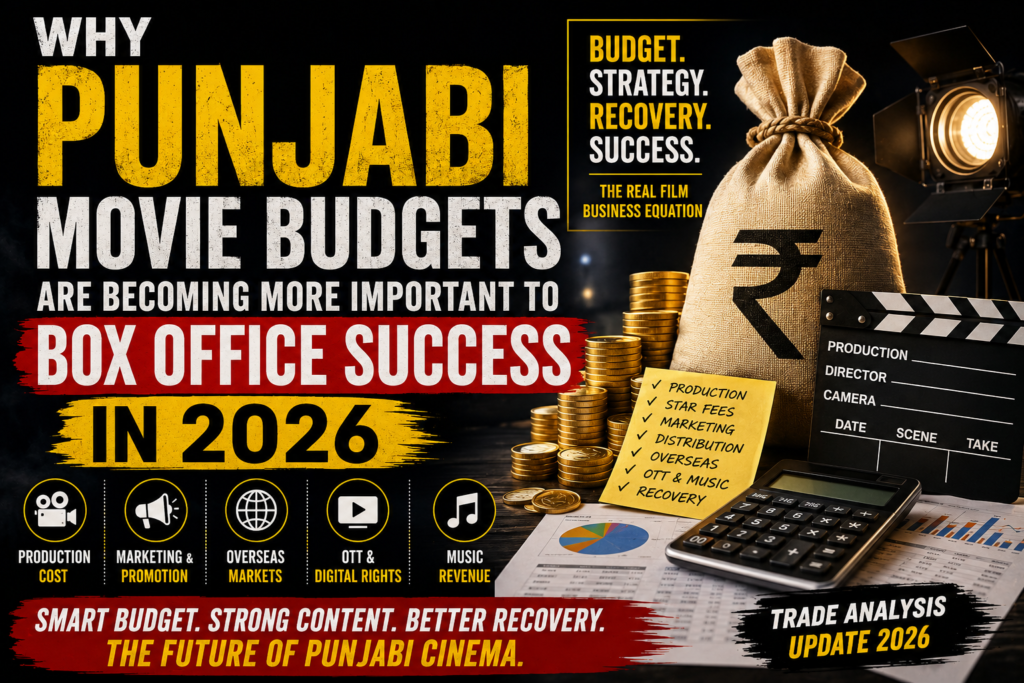
A trade-focused visual exploring how production costs, marketing, overseas markets, OTT and music revenue can influence the box-office economics of Punjabi movies.
Punjabi cinema’s commercial conversation is often dominated by opening-day collections, weekend numbers and overseas performance. But one factor sits behind almost every box-office calculation: the cost of making and releasing the film.
A movie does not need to become the highest-grossing Punjabi release to be commercially successful. Likewise, a film with a strong theatrical collection is not automatically profitable.
The relationship between budget, revenue and recovery is therefore becoming increasingly important for understanding Punjabi cinema in 2026.
For producers, distributors and trade observers, the relevant question is not simply how much a movie earns.
It is:
How much did the film need to earn to make the business work?
Why Budget Matters in Film Economics
Every theatrical movie begins with financial commitments.
These can include:
- Production expenses
- Artist remuneration
- Technical crew costs
- Locations
- Sets and equipment
- Post-production
- Music
- Marketing
- Publicity
- Distribution expenses
- Other release-related costs
The final financial structure can vary considerably from one film to another.
Two movies earning the same theatrical gross may therefore have very different commercial outcomes.
A lower-cost production may require a smaller recovery to reach its target.
A larger production may need significantly higher revenue across theatrical and non-theatrical channels.
This is why box-office gross should never be treated as the same thing as profit.
A Bigger Budget Does Not Guarantee a Bigger Hit
One of the most important principles in film economics is that spending more money does not automatically create greater audience demand.
A larger budget can provide access to:
- Bigger stars
- Larger production scale
- More locations
- Higher-end technical resources
- More extensive promotional campaigns
- Larger action sequences
- Greater visual production value
But audiences ultimately decide whether they want to watch the finished film.
A high-budget Punjabi movie can underperform if its content fails to connect.
A modestly budgeted film can perform strongly if it generates positive word of mouth and attracts the right audience.
The relationship is therefore not:
Higher Budget = Higher Box Office
A more accurate way to think about it is:
Appropriate Budget + Strong Content + Effective Distribution = Better Chance of Recovery
The Difference Between Production Budget and Total Investment
The word “budget” can sometimes create confusion.
A reported production budget may not include every expense associated with bringing a movie to the market.
For trade analysis, it is useful to distinguish between:
Production Cost
Money spent on actually making the film.
Marketing and Promotion
Expenses associated with creating awareness and promoting the release.
Distribution and Release Costs
Expenses and commercial arrangements involved in getting the movie into cinemas and markets.
Total Investment
The broader financial commitment associated with the project.
The exact structure differs between productions.
Therefore, PBO should avoid treating an unverified “budget” figure as a complete statement of a film’s total financial exposure.
Star Fees Can Influence Film Economics
Actor remuneration can represent an important component of a movie’s cost structure.
A film built around an established star may have greater upfront expenses than a project featuring emerging performers.
The commercial reasoning is understandable.
A recognised actor can potentially help with:
- Audience awareness
- Marketing
- Opening-day interest
- Distribution confidence
- Overseas recognition
- Brand value
But star power has to be evaluated against the overall economics of the project.
If a significant percentage of the available budget is concentrated in one area, less money may remain for production, marketing or distribution.
That does not mean star-driven films are financially inefficient.
It means their commercial model needs to be evaluated carefully.
Marketing Is Also Part of the Investment
Making a movie is only the first stage.
Audiences need to know that the movie exists.
Marketing can include:
- Trailers
- Songs
- Posters
- Digital campaigns
- Interviews
- Outdoor advertising
- Promotional events
- Social-media campaigns
- Influencer activity
- Television and digital promotion
A strong promotional campaign can help a movie achieve greater awareness before release.
However, marketing expenditure should also be considered in relation to the film’s target audience.
A campaign designed for a large-scale theatrical release may not make financial sense for a smaller niche project.
The right question is not simply how much was spent on marketing.
It is whether the marketing spend was appropriate for the film’s commercial objective.
Punjabi Cinema Needs Different Budget Strategies
Punjabi cinema does not operate exactly like Hindi cinema.
The potential domestic market is different, while overseas Punjabi audiences can play an important role in theatrical and digital recovery.
This means producers need to consider the likely revenue mix before finalising production expenditure.
A film might be designed primarily around:
- Punjab theatrical business
- Wider India
- Overseas theatrical markets
- OTT
- Music rights
- Satellite or television rights
- A combination of these channels
The budget should ideally reflect the expected commercial structure.
Overseas Markets Can Change the Recovery Equation
Punjabi films have audiences outside Punjab, particularly in markets with established Punjabi communities.
Canada, the UK, USA and Australia can provide additional theatrical opportunities.
But overseas distribution also involves its own costs and commercial considerations.
A producer cannot simply assume that international audiences will cover a large production budget.
The film still needs:
- Local distribution
- Suitable release dates
- Screens
- Marketing
- Audience demand
- Competitive positioning
This makes overseas performance valuable, but not automatically guaranteed.
Why OTT Rights Matter More in Budget Planning
The theatrical release is only one part of a film’s potential revenue ecosystem.
OTT platforms have created another route through which Punjabi films can reach audiences.
Depending on the project and licensing agreement, a film may generate value through digital rights.
This can be particularly relevant for films whose theatrical potential is limited but whose subject, cast or music gives them a wider streaming audience.
However, producers should not assume that every Punjabi film will command a significant OTT deal.
OTT value varies according to:
- Content
- Cast
- Audience demand
- Platform strategy
- Exclusivity
- Timing
- Existing market interest
Music Rights Can Add Another Revenue Stream
Music has always been closely connected with Punjabi entertainment.
A successful soundtrack can generate attention before theatrical release and potentially create additional commercial value through music rights.
For some projects, songs also become an important marketing tool.
A popular track can introduce audiences to:
- The film
- The actors
- The release date
- The characters
- The overall brand
But music performance should not be treated as a guaranteed indicator of theatrical success.
A film can have successful songs without achieving comparable box-office performance.
The Break-Even Question
The most important financial question for a producer is often:
At what point does the project recover its investment?
The answer is different for every film.
Suppose a hypothetical movie has a total financial exposure of ₹10 crore.
That does not mean the film must necessarily collect ₹10 crore in reported theatrical gross to become profitable.
The theatrical revenue is divided through the exhibition and distribution chain, while the movie may also generate revenue from OTT, music and other rights.
Therefore, a simplified calculation such as:
Box Office Gross – Budget = Profit
is not an accurate representation of film economics.
Any numerical example in this article is purely illustrative.
Why Gross Collection Can Be Misleading
Box-office gross is a useful measurement, but it is only one part of the financial picture.
A film’s theatrical revenue can move through different stages before the producer receives its applicable share.
The commercial structure can involve:
Audience Ticket Price → Gross Box Office → Taxes/Exhibition Economics → Distributor Share → Producer Recovery
The exact arrangements vary.
This is why PBO should distinguish between:
- Gross collection
- Distributor share
- Producer recovery
- Total revenue
- Profit
These terms should not be used interchangeably.
Opening Day Does Not Tell the Complete Story
A strong opening can improve a film’s chances of recovering its investment.
But a movie needs sustained demand to continue earning.
This is why the following sequence matters:
Opening Day → Weekend → Weekdays → Second Weekend → Final Run
A movie that opens strongly and holds well may have a very different financial outcome from one that opens strongly and then declines sharply.
For PBO’s trade coverage, the weekday and second-week trends are therefore important alongside the opening-day number.
Why Budget Discipline Matters
Budget discipline does not necessarily mean making a cheap movie.
It means ensuring that the amount spent is appropriate for the project’s commercial potential.
For example, a producer might decide that:
- A family comedy requires a moderate production scale.
- A large action film requires greater investment.
- A new-actor project should operate with controlled costs.
- A star-led film may justify higher expenditure if its revenue potential supports it.
The key is alignment.
Budget should follow commercial strategy.
Mid-Budget Films Can Have a Different Risk Profile
Mid-budget cinema occupies an interesting position.
Such films may not require the massive box-office numbers expected from expensive productions.
They can potentially benefit from:
- Controlled production costs
- Focused marketing
- Strong regional demand
- Overseas audiences
- OTT opportunities
- Music revenue
However, mid-budget does not automatically mean low risk.
A film still needs to attract enough viewers to recover its investment.
The advantage is that the required recovery target may be more manageable.
Low Budget Does Not Mean Low Quality
A controlled budget should not be confused with poor production value.
Modern filmmaking tools can allow producers to create technically strong content without spending at the scale of the largest productions.
The bigger challenge is deciding where money creates genuine audience value.
Spending heavily in areas that audiences do not notice may have less commercial impact than investing strategically in:
- Story
- Casting
- Production design
- Music
- Cinematography
- Marketing
- Distribution
Budget allocation can therefore be as important as the size of the budget itself.
Content Still Determines Audience Conversion
Financial discipline cannot compensate for a movie that audiences do not want to watch.
Theatrical demand depends on many factors:
- Story
- Genre
- Cast
- Trailer
- Songs
- Reviews
- Word of mouth
- Release timing
- Competition
- Audience expectations
A well-budgeted film can still struggle.
Likewise, a carefully controlled production can outperform expectations when the audience connects with it.
Budget is therefore a risk-management tool, not a substitute for content.
The Role of Release Timing
Budget planning should also consider the release environment.
A movie released during a crowded period may face competition for:
- Screens
- Shows
- Marketing attention
- Audience spending
A film with a relatively high cost may need a stronger release window to maximise its recovery opportunities.
This is particularly relevant when multiple Punjabi, Hindi and other regional-language films are scheduled around the same period.
Why Screen Retention Matters
A movie’s financial performance can be affected by how long it maintains theatrical availability.
Strong audience demand can help a film retain shows.
Weak demand can lead to reduced screenings.
This creates a feedback loop:
Audience Demand → Occupancy → Show Allocation → Revenue Opportunity
Budget therefore interacts with theatrical longevity.
A film with controlled costs may have greater flexibility even if its theatrical run is moderate.
The Importance of Distribution Strategy
A producer’s commercial planning does not end when the film is completed.
Distribution strategy determines how the movie reaches audiences.
Important decisions include:
- Domestic theatrical territories
- Overseas markets
- Number of screens
- Release timing
- Marketing strategy
- Distributor agreements
- OTT timing
- Rights negotiations
A strong film can still face commercial difficulties if its release strategy is poorly aligned with its audience.
International Audiences Should Be Part of the Planning
Punjabi cinema’s overseas audience makes budget planning more complicated but also creates additional opportunities.
A producer may evaluate whether a film has appeal in:
- Canada
- UK
- USA
- Australia
- New Zealand
- Other diaspora markets
But overseas potential should be assessed realistically.
A film’s genre, cast and cultural themes can influence international demand.
The existence of a Punjabi diaspora does not automatically guarantee a particular box-office result.
What Producers Should Ask Before Approving a Budget
Before production begins, several questions can help establish a realistic financial model:
1. Who is the target audience?
Is the movie designed primarily for Punjab, wider India, overseas audiences or a combination?
2. What is the likely theatrical scale?
Is it a limited release or a broad theatrical project?
3. What non-theatrical opportunities exist?
Are OTT and music rights likely to form part of the recovery strategy?
4. How much marketing is necessary?
Does the film need a large promotional campaign to reach its audience?
5. What happens if the opening is weak?
Can the project remain financially viable if theatrical performance falls below expectations?
These questions encourage producers to plan around risk rather than assuming the most optimistic outcome.
What Distributors Look Beyond the Budget
A distributor evaluating a Punjabi movie is likely to consider more than production cost.
Important commercial factors can include:
- Cast
- Genre
- Previous track record
- Release date
- Competition
- Trailer response
- Music
- Target market
- Overseas potential
- Expected audience
- Distribution terms
A film’s budget provides context, but it does not independently determine its commercial value.
Why PBO Should Be Careful With Budget Figures
Film budgets are often discussed publicly, but not every reported number is independently verified.
Some figures may come from:
- Producer statements
- Media reports
- Trade sources
- Industry estimates
- Promotional claims
These sources are not necessarily equivalent.
For an industry publication, PBO should clearly distinguish between a confirmed figure and a reported estimate.
If reliable evidence is unavailable, it is better to say that the budget has not been officially disclosed than to publish an unsupported number.
A Better Way to Analyse Punjabi Movie Success
Instead of asking:
“How much did the movie collect?”
trade analysis should ask:
- What was the reported budget?
- How reliable is that budget figure?
- What was the opening?
- How did the film perform during weekdays?
- What happened in the second week?
- How many screens did it retain?
- How did overseas markets perform?
- What non-theatrical rights were involved?
- What was the distributor structure?
- What level of recovery was required?
This produces a much more meaningful picture of commercial performance.
Budget and Box Office Should Be Viewed Together
A box-office number becomes more meaningful when placed against the film’s financial scale.
For example, a hypothetical ₹20 crore gross and a hypothetical ₹50 crore gross cannot be judged independently.
The commercial interpretation depends on:
- Cost
- Revenue sharing
- Rights income
- Distribution terms
- Marketing expense
- Overseas performance
This is why PBO’s trade coverage should increasingly focus on economics rather than collection headlines alone.
What 2026 Means for Punjabi Film Budgets
The Punjabi film industry is operating in a more connected entertainment environment.
Films can generate audience attention through:
- Theatrical cinema
- Overseas releases
- OTT
- Music platforms
- Social media
- Digital marketing
This creates more potential revenue channels.
But it also creates more competition.
Audiences have access to an enormous amount of entertainment, and producers must decide carefully where their investment creates the greatest value.
A controlled and clearly planned budget can therefore become an important competitive advantage.
The Future May Belong to Smarter Budgets
The next phase of Punjabi cinema does not necessarily require every movie to become more expensive.
It may require producers to become more precise about where they spend.
A film can be ambitious without being financially uncontrolled.
The most sustainable projects are likely to be those where:
Production Scale + Audience Demand + Distribution Strategy + Revenue Rights
are planned together.
This approach can reduce exposure while giving a film enough resources to compete theatrically.
Conclusion
Punjabi movie budgets are becoming more important to box-office analysis because the industry’s commercial ecosystem is becoming more complex.
A film’s success cannot be judged solely by its opening day or final gross.
Production expenditure, marketing costs, distribution arrangements, overseas opportunities, OTT rights, music revenue and theatrical performance all contribute to the overall business picture.
A high-budget movie may require substantial recovery to become commercially successful.
A smaller film may need considerably less.
Neither outcome can be determined by budget alone.
For Punjabi cinema in 2026, the more useful trade question is therefore not:
“Which movie spent the most?”
It is:
“Which movie managed its investment most effectively against its realistic revenue potential?”
That is where budget discipline becomes important.
The future of Punjabi cinema may not depend on making every production bigger. It may depend on making each investment smarter, better targeted and more closely connected to the audience and markets the film is actually designed to serve.
FAQs
Does a bigger Punjabi movie budget guarantee higher box office?
No. A larger budget can increase production scale, but audience demand, content, cast, marketing, release timing and competition remain important.
Is box-office gross the same as profit?
No. Gross collection is only one part of the theatrical financial structure. Distribution and exhibition arrangements affect the amount ultimately recovered by the producer.
Why are overseas markets important when planning a Punjabi movie budget?
Overseas markets can provide additional theatrical opportunities, particularly in countries with established Punjabi communities. However, overseas performance should be treated as potential revenue rather than guaranteed recovery.
Can OTT rights help recover a Punjabi movie’s investment?
OTT rights can form part of a film’s revenue strategy, depending on the project’s content, audience demand, platform interest and licensing agreement.
Are lower-budget Punjabi movies less successful?
Not necessarily. A controlled budget can reduce the amount of revenue required for recovery, but the film still needs to attract an audience.
Why should PBO avoid publishing unverified movie budgets?
Because an incorrect budget can distort the entire profitability analysis. Confirmed figures should be distinguished from trade estimates or media reports.





1 thought on “Why Punjabi Movie Budgets Are Becoming More Important to Box Office Success in 2026”