How Advance Booking Can Predict a Movie’s Opening Day
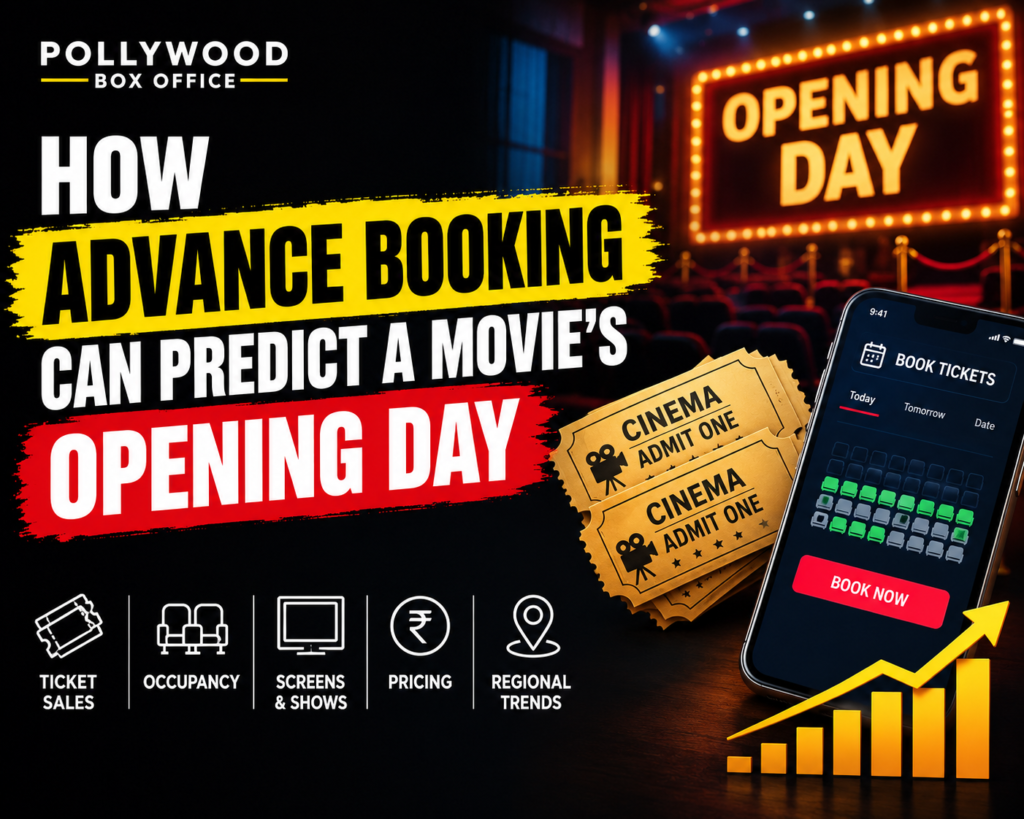
Advance booking provides an early indication of audience demand before a movie's theatrical release.
A movie’s box-office journey can begin several days before its first official show. Advance booking gives audiences the opportunity to purchase tickets before release and provides exhibitors, trade observers and entertainment publishers with an early indication of audience demand.
In India, advance booking has become an important part of opening-day box-office analysis. When a film records strong pre-release ticket sales, it can indicate that a portion of the audience has already committed to watching the movie on its first day. However, advance booking should not be treated as a guaranteed opening-day prediction.
The final result also depends on walk-in audiences, show availability, screen count, ticket prices, release timing, reviews and word of mouth.
What Is Movie Advance Booking?
Advance booking refers to tickets sold before a film officially opens in theatres.
Depending on the movie and release strategy, bookings can begin a few days before release or even earlier for highly anticipated films.
The basic idea is simple:
Tickets sold before release = early committed audience
This makes advance booking useful for understanding how much immediate demand exists for a movie.
For example, if a film has already sold a large number of tickets for its opening day before the first show begins, those ticket sales are effectively part of the opening-day audience.
Why Advance Booking Matters for Opening Day
The opening day is heavily influenced by how many people are willing to watch a film immediately rather than waiting for reviews or word of mouth.
A strong advance booking trend can therefore indicate:
- strong pre-release awareness
- established fan demand
- effective marketing
- franchise popularity
- strong star appeal
- favourable release timing
- audience willingness to pay for an early theatrical experience
Recent Indian releases have demonstrated how closely trade observers monitor this relationship. For example, advance sales for Drishyam 3 were being used as an early indicator of its opening potential ahead of its October 2, 2026 release.
The Basic Relationship Between Advance Booking and Opening Day
The simplest way to understand the relationship is:
Advance Booking + Same-Day Ticket Sales = Opening-Day Gross
Advance booking represents tickets purchased before release, while additional tickets can be sold on the release day itself.
Therefore, a movie with high advance sales already has a certain level of committed business before release morning.
A movie with weaker advance sales has more dependence on same-day bookings and walk-in audiences.
This is why advance booking can provide an early indication of opening-day strength without being a complete forecast.
Ticket Count Can Be More Useful Than Just Collection
When analysing advance booking, looking only at the rupee value can sometimes be misleading.
A useful analysis should also consider:
Number of tickets sold
Number of shows
Number of screens
Occupancy
Average ticket price
City and state distribution
Suppose Movie A generates ₹5 crore from advance booking through expensive premium shows, while Movie B generates the same amount through a much larger number of tickets.
The two films may have different audience patterns despite having the same reported advance collection.
This is why professional box-office analysis should examine multiple indicators rather than relying on one headline figure.
Screen Count and Show Availability Matter
A film cannot sell tickets in theatres where it does not have shows.
This makes screen availability an important factor when interpreting advance booking.
A film playing across a large number of screens has more opportunities to generate ticket sales than a film with a limited release.
The same principle applies to show density. More shows create more available seats, which can increase the possible opening-day collection.
Box-office forecasting therefore involves more than simply asking how many tickets have already been sold. The potential supply of seats also matters.
Occupancy Gives Advance Booking More Context
Occupancy measures how much of the available seating capacity has been booked.
For example, 80% occupancy across a limited number of shows and 40% occupancy across a very wide release can tell different stories.
High occupancy in major markets can indicate strong local demand.
When strong occupancy is combined with expanding show counts, it can become a more meaningful signal of opening-day momentum.
However, occupancy can change quickly as new shows are added and more tickets become available.
City-Wise and Regional Booking Trends
India’s theatrical market is not uniform.
Different films perform differently across states, cities and languages.
A Punjabi film may show particularly strong booking momentum in Punjab and Chandigarh, while a Hindi film could have a wider distribution across several major markets.
Likewise, a Telugu, Tamil, Kannada or Malayalam film can have strong regional demand that may not be reflected by looking only at national averages.
For this reason, box-office analysis should ideally examine:
- major metropolitan markets
- home-state performance
- tier-2 and tier-3 cities
- regional language markets
- overseas markets where relevant
This becomes particularly important for pan-India releases.
Ticket Prices Can Change the Meaning of Advance Collections
Another important factor is ticket pricing.
A film playing premium formats or high-priced metropolitan shows can generate substantial advance revenue with fewer tickets than a film selling tickets at lower average prices.
Therefore:
Advance gross ≠ exact audience size
Ticket count can provide additional context.
This is one reason box-office reports often need to distinguish between ticket sales, gross collections and net collections.
Advance Booking Can Show Fan Commitment
One of the clearest signals from advance booking is the behaviour of the committed audience.
People who purchase tickets several days before release have already decided that they want to watch the film.
This can be particularly significant for:
- major franchises
- superstar-led films
- event movies
- festival releases
- highly anticipated sequels
- films with strong fan communities
However, advance booking tells us less about people who decide whether to watch a film only after seeing reviews or hearing audience reactions.
That distinction is important.
Why Weak Advance Booking Does Not Always Mean a Weak Opening
A movie can have modest pre-sales and still perform strongly after release.
There are several reasons.
The trailer may not have converted casual viewers into early buyers, but positive reviews could encourage them to purchase tickets on the release day.
Strong word of mouth can also increase Saturday and Sunday demand.
This is especially relevant for content-driven films, where audience response may become an important part of the commercial story after the first shows.
Therefore, weak advance booking should not automatically be interpreted as a final verdict on a movie’s theatrical performance.
Why Strong Advance Booking Does Not Guarantee Long-Term Success
The opposite is also true.
A film can have excellent advance sales because of star power, franchise recognition or pre-release excitement.
But strong advance sales do not guarantee a long theatrical run.
After the first shows, audiences begin responding to the actual film.
Reviews, audience reactions and word of mouth can influence the second day, weekend and subsequent weeks.
This creates an important distinction:
Advance booking can help analyse the opening.
Audience response helps determine what happens after the opening.
Festival Releases Can Make Advance Booking More Important
Release timing also affects the value of advance booking.
A film releasing around a major holiday or festival can benefit from increased audience availability.
In such cases, early booking may accelerate because audiences plan their cinema visits in advance.
However, holiday demand should not be confused with pure film-specific demand.
The calendar itself can increase theatrical activity.
Therefore, any opening-day analysis should mention the release date and the surrounding holiday or event calendar.
Advance Booking and Punjabi Cinema
Advance booking can be particularly useful for understanding the theatrical performance of Punjabi films.
Punjabi cinema has audiences across Punjab, Chandigarh, Delhi-NCR and other Indian cities, along with significant overseas markets.
For a Punjabi film, state-wise and city-wise booking patterns can reveal where the strongest initial demand is developing.
For example, analysts can compare:
Punjab + Chandigarh
with
Delhi-NCR + other Indian markets
and, where reliable data is available, overseas markets.
This can help explain whether a film’s opening is primarily driven by its core Punjabi audience or by broader audience expansion.
A Simple Method to Analyse Advance Booking
For readers trying to understand an upcoming movie’s opening potential, a simple framework can be used.
Step 1: Check Advance Collection
Look at the reported advance gross or net figure.
Step 2: Check Tickets Sold
Compare the reported revenue with the number of tickets sold.
Step 3: Check Shows and Screens
Find out how widely the film is releasing.
Step 4: Check Occupancy
Strong occupancy across multiple markets can indicate healthy demand.
Step 5: Check Regional Distribution
Identify which states and cities are generating the most bookings.
Step 6: Check Ticket Pricing
Determine whether premium pricing is influencing the collection.
Step 7: Consider Release-Day Factors
Look at holidays, competition, reviews and expected walk-in demand.
Step 8: Separate Signal From Prediction
Use advance booking as an indicator, not as a guaranteed opening-day number.
Why Advance Booking Is Becoming an Important Box-Office Metric
The growth of online ticketing has made pre-release demand easier to observe.
Entertainment platforms and box-office trackers can now monitor ticket sales, shows and booking trends before the first public show.
Current box-office reporting platforms explicitly describe advance booking as an early view of audience interest while also noting that final collections depend on additional factors such as walk-ins, show availability and audience response.
This has made advance booking an important part of modern theatrical analysis.
Advance Booking Should Be Read as a Signal, Not a Guarantee
The biggest mistake in box-office analysis is treating one number as the complete story.
A strong advance booking figure can suggest strong opening-day demand.
But the final collection can still change depending on:
- walk-in audiences
- additional shows
- screen count
- ticket prices
- occupancy
- reviews
- word of mouth
- competing releases
- holiday timing
- regional audience behaviour
Therefore, the correct approach is to combine advance booking with these additional factors.
Conclusion
Advance booking can provide one of the clearest early signals of a movie’s opening-day potential, but it cannot guarantee the final collection.
The strongest analysis looks beyond the headline number and studies ticket sales, occupancy, show count, screen availability, ticket prices and regional demand.
Pollywood Box Office News Network