
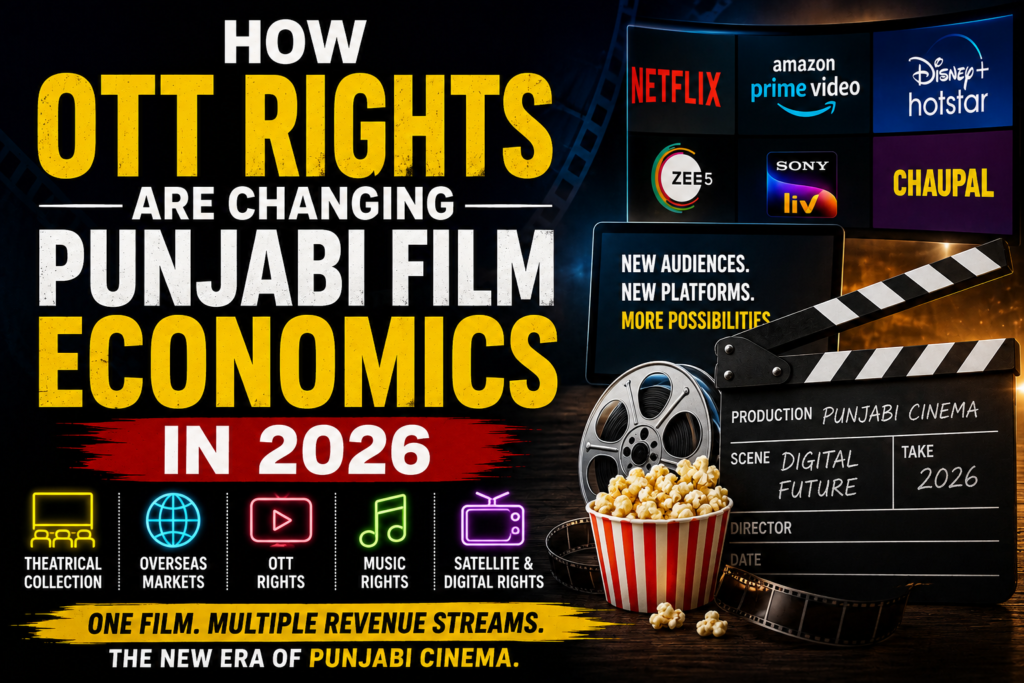
OTT platforms are creating new opportunities for Punjabi films through digital rights, wider audience reach, overseas access and multiple revenue streams.
Punjabi cinema’s business model is no longer built around theatrical collections alone.
For years, the box office remained the most visible measurement of a film’s commercial performance. Opening day, weekend collections, overseas numbers and final gross often dominated trade discussions.
But the growth of streaming has added another important layer to the economics of Punjabi films.
A movie can now have several commercial stages:
Theatrical Release → Overseas Distribution → OTT → Music → Television/Digital Rights → Long-Term Audience
This does not mean theatrical cinema has become less important. Instead, OTT has made the overall financial structure of a Punjabi film more diversified.
For producers, distributors and trade analysts, the key question in 2026 is increasingly:
How should a Punjabi movie’s theatrical and digital value be evaluated together?
OTT Has Changed the Life Cycle of a Punjabi Movie
Traditionally, a movie’s commercial journey was strongly connected to its theatrical run.
A film would open in cinemas, continue for several weeks depending on demand and eventually move into other forms of distribution.
Streaming has changed this timeline.
A Punjabi movie can now reach audiences who may not have had access to a theatrical screening in their city or country.
This creates a second major audience window.
The theatrical and streaming stages serve different purposes.
Theatre: Immediate audience spending and event-based viewing.
OTT: Wider accessibility and longer-term discoverability.
Both can contribute to the overall value of a film.
OTT Is Not Simply a Replacement for Theatres
It would be incorrect to view streaming as automatically replacing theatrical cinema.
The two platforms offer different experiences.
Theatre provides:
- Large-screen viewing
- Collective audience experience
- Opening-weekend excitement
- Event positioning
- Immediate box-office revenue
OTT provides:
- Convenience
- Wider geographical access
- Flexible viewing
- Longer availability
- International accessibility
- Potential discovery by new audiences
For Punjabi cinema, this distinction is particularly important because the audience is geographically distributed.
A movie may have a theatrical presence in Punjab, selected Indian cities and overseas markets, while later reaching a much wider audience through streaming.
Theatrical Performance Still Matters
The availability of OTT does not eliminate the importance of a film’s theatrical performance.
A strong theatrical run can create:
- Audience awareness
- Media coverage
- Social-media conversation
- Star visibility
- Franchise value
- Stronger long-term recognition
The cinema release can effectively act as the first major public test of a movie.
Its performance can also influence how audiences perceive the film before it becomes available digitally.
This makes theatrical positioning important even when OTT forms part of the planned revenue structure.
OTT Can Expand the Addressable Audience
One of the biggest advantages of streaming is geographical reach.
A Punjabi movie may have limited theatrical availability in a particular city because the local audience is too small to justify regular screenings.
OTT removes some of that physical limitation.
A viewer can potentially watch the film from:
- A smaller Indian city
- A city outside Punjab
- A smaller overseas Punjabi community
- A location without a Punjabi-language theatrical release
This is particularly relevant for Punjabi cinema because its audience exists across multiple countries.
Overseas Audiences Benefit From Streaming
Punjabi cinema has established audiences in markets such as Canada, the UK, USA and Australia.
However, not every Punjabi film can receive the same level of theatrical distribution in every country.
OTT can provide another route to those audiences.
A viewer who cannot find a film at a local cinema may eventually discover it on a streaming platform.
This creates a broader international audience opportunity.
But the presence of an overseas audience does not automatically translate into a large OTT deal.
Platform interest still depends on the individual film.
OTT Deals Can Become Part of Budget Planning
For producers, streaming rights can influence financial planning.
Before production begins, a producer may consider potential revenue from:
- Theatrical distribution
- Overseas theatrical rights
- OTT rights
- Music rights
- Television rights
- Other digital rights
The exact combination differs from film to film.
A project designed around a relatively controlled budget may have a different recovery strategy from a large-scale star-driven production.
This is why OTT should be considered as part of the broader financial model rather than treated as an additional bonus after production.
But Producers Should Not Assume an OTT Deal
One of the biggest risks in film budgeting is assuming revenue before it is confirmed.
A producer may expect strong streaming interest because:
- The cast is popular
- The genre is commercially attractive
- The film has a successful franchise
- The music is performing well
- The theatrical release is expected to be strong
But expectations are not the same as a confirmed acquisition.
OTT platforms make their own decisions based on their content strategy, audience demand and commercial considerations.
Therefore, an unconfirmed potential OTT value should not be presented as guaranteed recovery.
The Value of OTT Rights Varies From Film to Film
There is no universal formula for determining the value of Punjabi digital rights.
Several factors can influence interest:
Cast
Recognised actors can increase audience awareness.
Genre
Some genres may have stronger streaming appeal than others.
Content
A strong story can increase long-term viewing potential.
Franchise Value
Established properties may have an existing audience.
Theatrical Performance
Theatrical response can influence awareness and audience interest.
Music
Popular songs can help generate digital discovery.
International Appeal
A film with diaspora relevance may have additional streaming potential.
Platform Strategy
A streaming service may value a film differently depending on its own content requirements.
Punjabi Content Can Have a Long Digital Tail
A theatrical film has a limited cinema window.
Once the theatrical run ends, its availability becomes more restricted depending on distribution.
Streaming can give the movie a longer period of audience discovery.
A person who missed the theatrical release may discover the film months later.
A younger viewer may find an older Punjabi movie through a streaming recommendation.
This creates what can be described as a long digital tail.
The commercial importance of a film can therefore extend beyond its initial theatrical period.
OTT Can Help Older Punjabi Films Find New Audiences
Streaming does not only benefit new releases.
Older Punjabi films can also become discoverable when they are added to digital catalogues.
This can introduce previous generations of Punjabi cinema to younger viewers.
It can also help diaspora audiences reconnect with films they may not have been able to watch when they were originally released.
For the industry, this creates another form of catalogue value.
Music and OTT Can Work Together
Music is an important part of Punjabi entertainment.
A song may become popular independently of the movie.
When audiences encounter the soundtrack online, they may subsequently discover:
- The trailer
- The actors
- The film
- Interviews
- Behind-the-scenes content
- The OTT release
This creates a connected digital discovery chain.
Song → Artist → Film → Trailer → Streaming
However, music popularity should not automatically be treated as evidence of a successful film.
The two measurements remain different.
Social Media Makes Digital Discovery Faster
Social platforms have reduced the distance between a film and its audience.
A Punjabi movie can be promoted simultaneously to audiences in India and overseas.
Short clips, songs, interviews and audience reactions can circulate quickly.
When a film eventually arrives on OTT, those existing digital conversations can help audiences discover it.
This means marketing does not necessarily end with the theatrical release.
The digital campaign can continue into the streaming window.
The OTT Release Date Matters
The timing of an OTT release can influence audience interest.
If a movie moves to streaming too quickly, some audiences may question the urgency of watching it theatrically.
If the digital release comes after a meaningful theatrical window, the two stages can operate more distinctly.
The appropriate timing depends on:
- Theatrical performance
- Distribution agreements
- Platform strategy
- Audience demand
- Market expectations
There is no universal number of days that works for every film.
Early OTT Availability Can Affect Theatrical Psychology
Audiences make choices based on perceived value.
If viewers believe a film will become available online very soon, some may decide to wait.
This does not mean early streaming always harms box office.
A highly anticipated film can still attract audiences to theatres despite knowing that an OTT release will eventually follow.
But the perceived gap between theatrical and streaming availability can influence some viewers.
This makes window strategy an important part of modern film economics.
Theatrical and OTT Audiences Are Not Identical
A cinema audience may include:
- Families
- Groups of friends
- Fans
- Young audiences
- Overseas theatre-goers
Streaming audiences may include:
- Viewers who prefer home entertainment
- People in smaller markets
- International viewers
- Audiences who missed the theatrical run
- Younger digital-first viewers
There is overlap, but the two groups are not necessarily identical.
Understanding these differences can help producers decide how to position a film.
OTT Can Reduce Dependence on One Revenue Channel
A film relying entirely on theatrical revenue faces substantial uncertainty.
Weather, competition, screen availability, audience reaction and release timing can all affect the theatrical result.
Multiple rights can diversify the financial structure.
The model can become:
Theatrical + Overseas + OTT + Music + Television + Other Rights
However, diversification does not eliminate risk.
Each revenue stream has its own market conditions.
Why Budget Discipline Still Matters
OTT has created additional revenue opportunities, but that does not mean producers should automatically increase budgets.
A movie still needs a sensible financial structure.
If production costs rise substantially on the assumption that digital rights will cover the difference, the project can become exposed if the expected deal does not materialise.
This is why OTT should support a sound budget strategy rather than justify uncontrolled spending.
Star Fees and Digital Economics
Star-driven Punjabi films may have greater awareness across theatrical and digital markets.
An established actor can potentially help a film generate interest before release.
But higher star remuneration also increases production expenditure.
The commercial question becomes:
Does the additional audience value justify the additional cost?
This is not always easy to measure.
The answer depends on the actor, film, genre, audience and distribution strategy.
What OTT Means for Mid-Budget Punjabi Films
Mid-budget films could potentially benefit from the changing ecosystem.
A controlled production may have several potential routes to recovery.
If theatrical performance is moderate, the film may still reach a wider audience through streaming and other rights.
This does not guarantee profitability.
But it can provide more flexibility than a business model dependent entirely on a large theatrical collection.
Small Films Also Have a Digital Opportunity
OTT can be especially relevant to films without major theatrical scale.
A small Punjabi film may struggle to secure extensive cinema screens.
Streaming can provide access to audiences who would otherwise never encounter the film.
This can help independent filmmakers reach audiences based on:
- Story
- Genre
- Reviews
- Cultural relevance
- Digital discovery
For smaller productions, OTT can therefore function as an important distribution tool.
The Risk of Measuring Success Only Through OTT
The opposite mistake is also possible.
A film appearing on a major streaming platform does not automatically mean it has achieved a major commercial success.
Likewise, streaming availability does not reveal the exact economics of the deal unless the financial terms are publicly disclosed.
Trade reporting should therefore avoid statements such as:
“The film recovered its entire budget through OTT”
unless reliable evidence confirms it.
Transparency Is Important in Punjabi Trade Reporting
As Punjabi cinema becomes more commercially sophisticated, reporting standards also need to improve.
PBO should distinguish clearly between:
Confirmed
Reported
Estimated
Unknown
For example:
“The film’s digital deal has been reported by industry sources.”
is different from:
“The film officially sold its OTT rights for a confirmed amount.”
This distinction protects the credibility of trade reporting.
OTT Does Not Remove the Importance of Box Office
Theatrical collections remain an important part of the Punjabi film industry.
They provide a public indicator of audience demand.
A strong theatrical performance can also strengthen the film’s overall market profile.
But box office should now be viewed as one part of a larger commercial ecosystem.
The complete picture can involve:
Box Office + Distribution + OTT + Music + Overseas + Other Rights
This broader framework is increasingly relevant in 2026.
What Producers Should Consider Before Making a Film
A producer planning a Punjabi movie can consider several questions.
Who is the primary audience?
Punjab, India, overseas or a combination?
What is the realistic theatrical scale?
Limited, regional or wide release?
Does the story have digital appeal?
Can it attract audiences beyond the theatrical market?
Is there overseas potential?
Can the film connect with Punjabi audiences internationally?
What is the music strategy?
Can the soundtrack support awareness?
What happens if theatrical performance is weak?
Does the financial model remain sustainable?
These questions can make budget planning more realistic.
What Distributors Should Evaluate
Distributors can consider:
- Release date
- Competition
- Cast
- Genre
- Trailer response
- Music
- Punjab demand
- Wider India demand
- Overseas demand
- Screen availability
- Expected theatrical performance
OTT does not eliminate these considerations.
Instead, it becomes another part of the film’s overall lifecycle.
What Trade Analysts Should Track
A modern PBO analysis can look beyond theatrical collections.
Useful categories include:
| Area | What to Examine |
|---|---|
| Production | Budget and cost structure where verified |
| Theatrical | Opening, weekend and weekday performance |
| Overseas | Territory-level performance where available |
| OTT | Confirmed platform and release information |
| Music | Officially reported digital performance |
| Distribution | Rights and territory structure |
| Audience | Reviews and sustained interest |
| Long Term | Catalogue and streaming reach |
This approach gives readers a more complete understanding of film economics.
The Future Could Be a Hybrid Film Business
Punjabi cinema’s future is unlikely to be purely theatrical or purely digital.
The more realistic model is hybrid.
A movie may begin with a theatrical campaign, expand through overseas markets, continue through OTT and remain discoverable through music and social media.
Each stage can serve a different purpose.
Theatrical creates immediacy.
OTT creates accessibility.
Music creates discovery.
Social media creates conversation.
Overseas distribution expands geography.
Together, these channels can create a more connected Punjabi entertainment economy.
2026 and the Changing Definition of Film Success
The definition of a successful Punjabi movie is becoming more complicated.
Previously, trade conversations could focus heavily on theatrical performance.
Today, a more complete assessment may ask:
- Was the theatrical release successful?
- Did the film perform in overseas markets?
- Did it find an OTT audience?
- Did its music travel?
- Did the film build long-term recognition?
- Was the overall investment appropriate?
- Were multiple rights successfully monetised?
Not every film will succeed across every category.
That is normal.
The objective is to understand the complete business rather than reduce everything to one number.
Conclusion
OTT is changing Punjabi film economics by giving producers another route to audiences and another potential component of the revenue structure.
Theatrical cinema remains important, but it is increasingly one stage in a longer commercial journey.
A Punjabi movie can move from cinema to overseas markets, then to streaming, while music and social media continue to support audience discovery.
This creates opportunities for large productions, mid-budget films and smaller projects.
But OTT should not be treated as guaranteed financial recovery.
Digital rights vary according to the film, platform, audience, content, cast and market conditions. Unless financial terms are officially disclosed, reported deal values should not be presented as confirmed revenue or profit.
For Punjabi cinema in 2026, the most sustainable approach may therefore be to think beyond a single box-office number.
The modern film business can be viewed as:
Production → Theatrical → Overseas → OTT → Music → Long-Term Audience
The producers who understand how these stages interact may be better positioned to manage risk and maximise the commercial life of their films.
For PBO, that also means the future of Punjabi trade reporting should increasingly examine the complete revenue ecosystem, rather than treating the theatrical collection as the entire story.
FAQs
Are OTT rights important for Punjabi movies in 2026?
Yes. OTT can provide another distribution and potential revenue channel, particularly for audiences who do not have access to a theatrical release.
Does an OTT deal guarantee that a Punjabi movie is profitable?
No. Profitability depends on the overall investment, theatrical revenue, rights income and distribution arrangements.
Can OTT help smaller Punjabi movies?
It can provide smaller films with access to audiences beyond their theatrical footprint, although platform availability and acquisition decisions vary.
Does OTT reduce the importance of cinemas?
No. Theatrical and streaming releases serve different purposes and can complement each other.
Can music increase the value of a Punjabi movie?
Music can contribute to awareness and audience discovery, but music popularity should not automatically be equated with theatrical or overall film profitability.
Should reported OTT deal amounts be treated as confirmed?
Only when the financial terms have been reliably disclosed. Otherwise, they should be identified as reported or estimated figures.



1 thought on “How OTT Rights Are Changing Punjabi Film Economics in 2026”